June 17, 2026
6 min read
Epic's GenAI Art Pipeline: Why Artists Are Fixing AI Errors
Key Takeaways
- •The Allure of the Instant Asset
- •The GenAI Pipeline: GenMedia and Nano Banana
- •Debugging Art vs. Debugging Code
The Allure of the Instant Asset
As game developers, we are constantly hunting for ways to optimize our pipelines. Whether it is automations in level design, compiler optimizations, or asset generation, the pressure to deliver content faster is relentless. This week, Epic Games released a behind-the-scenes video titled A Look At Epic’s Art Concepting Process, showcasing how their art team leverages generative AI tools directly within Unreal Engine to create assets for Fortnite.
On the surface, the video presents a workflow where artists collaborate with machine intelligence to skip the tedious rendering steps. But as someone who spends their days architecting systems and designing levels, I watched the footage with a growing sense of skepticism. What Epic presents as a seamless velocity multiplier actually exposes a significant bottleneck: the cognitive and manual overhead of "debugging" AI art.
In this industry, we often talk about technical debt, but we are entering an era of design debt. When we use tools that generate random visual noise, we are not saving time—we are simply shifting the labor from creation to correction.
The GenAI Pipeline: GenMedia and Nano Banana
The video outlines a workflow that begins with traditional hand-drawn character sketches and layouts. However, the pivot to automation happens when these assets enter Epic's proprietary AI tools.
First, we see the concept artist transition their character sketch into a tool called GenMedia. The artist inputs a text prompt: “Clean up the rendering on this Fortnite character. Don’t change the design, just the rendering.” With a click, the system renders a high-fidelity character. But a closer look reveals that the AI did not just render the drawing; it hallucinated new details:
- A skeleton emblem added to a belt pouch.
- An entirely new second belt pouch on the character's side.
- An unsanctioned glove.
- Errant distortions around the collar.
To correct these errors, the human artist is shown manually painting over the AI's mistakes.
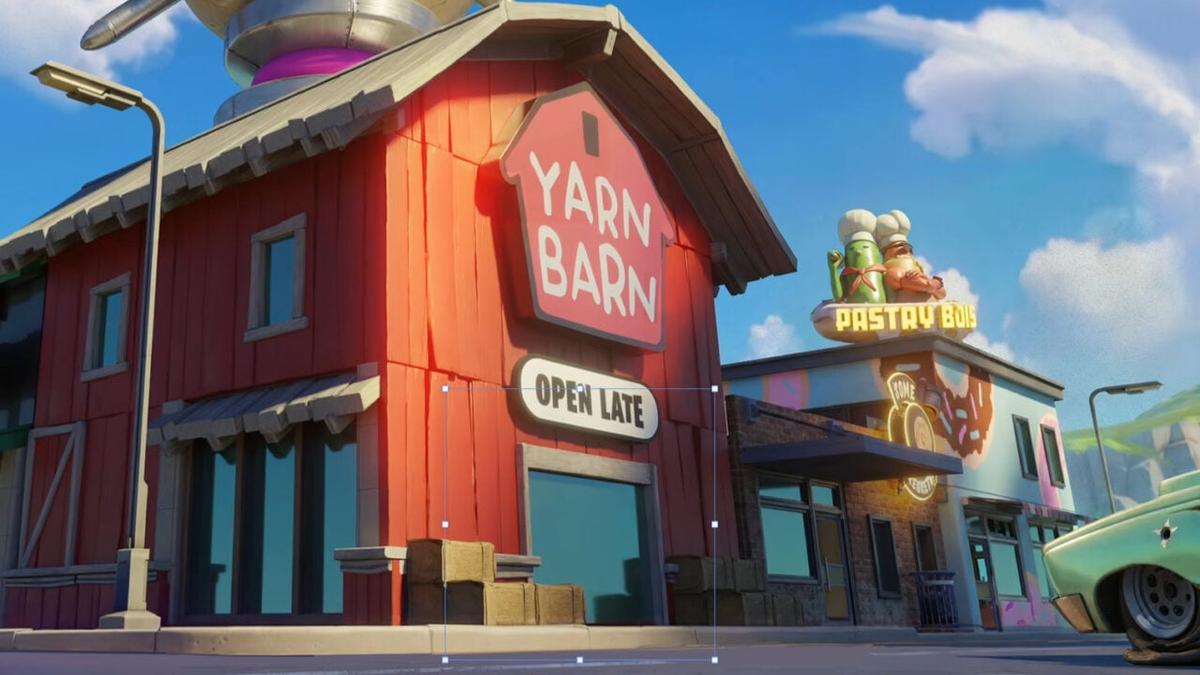
Later in the video, Epic demonstrates another tool named Nano Banana, used for rendering buildings. The artist prompts it for "clean PBR render shots" while adjusting the perspective. Once again, the output contains subtle structural errors—discrepancies in the central sign tower and warped window frames—that the artist must manually edit.
Here is a look at how this loop compares to a traditional concept art pipeline:
Debugging Art vs. Debugging Code
To a programmer, this loop is intimately familiar. It is the visual equivalent of debugging someone else's messy code. Every developer knows that writing a system from scratch is often faster than reading, understanding, and fixing a buggy codebase written by an amateur.
In the traditional art pipeline, the artist holds a complete mental model of every stroke, line, and color choice. When generative AI injects random elements, that mental model is broken. The artist must switch from a mode of pure creativity to one of quality assurance, scanning the image for "visual bugs" like extra pouches, mismatched perspectives, or missing fingers.
Epic Games defends the pipeline by emphasizing human oversight:
"All along the way there are continual reviews before anything makes it into our games, and artists are careful to respect originality, track provenance of their work, and make sure the finished product meets Epic’s high-quality standards."
While this sounds reassuring, it ignores the systemic pressure that these tools introduce to studio environments.
The Fortnite Pattern: A History of Visual Bugs
This is not the first time Epic’s generative AI integration has drawn public scrutiny. Six months ago, the Fortnite player community pointed out blatant visual anomalies in the game's in-game signage. Players discovered a nine-toed character lounging in a hammock and clocks with warped, unreadable numbers—classic hallmarks of unrefined generative AI.
Furthermore, a year ago, Epic faced controversy when players manipulated a generative AI Darth Vader voice-cloning tool to produce dialogue that violated community guidelines. These incidents demonstrate that when a pipeline relies on generative models, errors are not a possibility; they are a statistical certainty.
| AI Tool | Intended Use | Scraped Incident / Error |
|---|---|---|
| GenMedia | Character Render Pass | Hallucinated belt pouches, skeleton emblems, and collar distortions |
| Nano Banana | Building PBR Render | Sign tower discrepancies and warped window placements |
| In-Game Signage | World Environmental Art | A nine-toed character in a hammock, distorted clocks |
| Voice Cloning | Character Dialogue | Darth Vader voice-cloning safety bypasses |
When we look at this matrix of failures, it becomes clear that human QA is a fragile firewall. When deadlines shrink, the visual bugs slip through.
The Economic Context: The Layoff Leverage
We cannot analyze Epic's technology stack without acknowledging their recent business decisions. Just three months ago, Epic Games laid off 1,000 employees, citing a drop in Fortnite engagement and budget overruns.
When a studio lays off a tenth of its workforce and simultaneously rolls out video presentations celebrating generative tools that "speed up" the art process, the message is clear. Generative AI is not being used to grant remaining artists more creative breathing room. Instead, it is a tool of compression—designed to extract the same amount of content from a smaller, stressed team under tighter deadlines.
When a single artist is tasked with overseeing five times the volume of assets by using AI generators, their ability to spot a nine-toed character or a skewed sign tower drops drastically. The result is a drop in overall design quality, covered up by a layer of superficial polish.
Retaining the Human Element in Game Design
In my own work, I specialize in Unity and Unreal development, level design, and building custom tooling. I understand the temptation to automate. But there is a line between automation that assists execution (like procedural generation for foliage or terrain) and automation that replaces intent.
A procedural tool follows mathematical rules set by the designer. A generative AI tool predicts the next most likely pixel based on a database of scraped work, leading to the generic "shiny" aesthetic criticized by players.
We must ask ourselves what kind of experiences we want to build. If we rely on algorithms to do the rendering, the layout, and the detailing, we risk producing games that feel like they were made by a committee of algorithms. The quirks, the intentional asymmetry, and the deliberate design choices are what give games their soul.
If you are a developer looking to optimize your asset pipeline without sacrificing human intent, or if you want to chat about balancing automation and design in Unreal Engine, feel free to reach out to me directly through my contact page. Let's build something authentic.