June 16, 2026
7 min read
Training the Next Generation of Neural Engines: What NVIDIA's Blackwell MLPerf 6.0 Benchmarks Mean for Game Developers
Key Takeaways
- •Blackwell's Architecture: FP4, FP8, and the Transformer Engine
- •Neural Rendering: Training DLSS, Frame Gen, and Neural Path Tracing
- •Scaling Reinforcement Learning for Character Physics and Motion Matching
Every breakthrough in modern game development—from real-time path tracing to realistic physics simulation—ultimately begins with a training run. As video game technology moves beyond rasterization and hand-crafted heuristics toward neural rendering and generative AI systems, the infrastructure powering these training workloads has become a critical bottleneck. The speed at which a development studio can train models directly defines the speed of their iteration cycles, the scale of the neural architectures they can deploy, and the reliability of their systems.
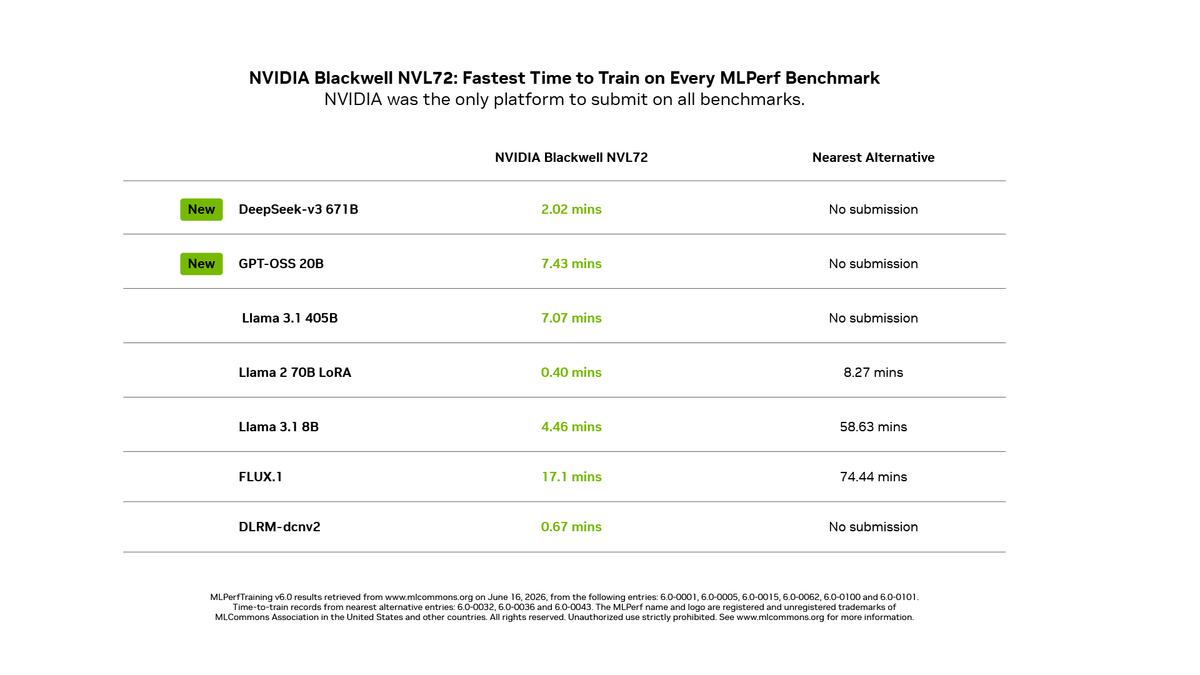
NVIDIA’s recent performance sweeps in the MLPerf Training 6.0 benchmarks highlight a massive leap in processing capabilities with the debut of the Blackwell architecture. For game developers and technical directors, this is not just an enterprise milestone; it is the starting gun for the transition to fully neural-driven game engines. With Blackwell, training tasks that previously took days on Hopper architecture are completed in fraction of the time, paving the way for studios to train bespoke, game-specific neural networks.
In modern AAA pipelines, developers are increasingly relying on machine learning models to solve complex runtime issues:
- Neural Reconstruction: Dynamic upscaling, anti-aliasing, and frame generation.
- Neural Character Controllers: Physics-based locomotion trained via Reinforcement Learning (RL).
- Automated QA Agents: High-fidelity bots trained to navigate environments and find collision bugs.
These models cannot simply be downloaded off the shelf; to achieve maximum fidelity and prevent glitches, they must be trained on a game's specific asset library, levels, and mechanics. The MLPerf 6.0 results show that Blackwell's training efficiency provides the raw computational throughput required to make local studio training pipelines feasible.
Blackwell's Architecture: FP4, FP8, and the Transformer Engine
The architectural core of Blackwell's training speed lies in its second-generation Transformer Engine. Unlike traditional training pipelines that rely on high-overhead FP32 or FP16 floating-point calculations, the Transformer Engine dynamically adjusts precision during the training loop. By scaling calculations down to FP8 and even FP4 precision where acceptable, Blackwell multiplies compute density and bandwidth without sacrificing model convergence.
This dynamic precision scaling is particularly valuable for game developers training neural shaders and reinforcement learning policies:
- Dynamic Precision Selection: The engine monitors the range of weights in each layer of the neural network during training.
- Automated Quantization: Non-critical layers (such as early feature extractors in image reconstruction models) are cast to FP8 or FP4.
- Loss Scaling Safeguards: Critical layers (such as policy headers or final color space converters) are kept at higher precision to prevent gradient underflow.
This mathematical optimization reduces the memory footprint of training models, allowing studios to fit larger, more complex networks into the GPU's local high-bandwidth memory (HBM3e). It also speeds up the backpropagation pass, enabling developers to run multiple training iterations concurrently.
Here is a high-level flowchart of the Transformer Engine's dynamic precision selection pipeline during a game dev training run:
By utilizing these low-precision formats, a Blackwell-based training cluster can process training datasets—such as thousands of hours of high-fidelity character motion-capture data—with a fraction of the power and time required by previous generations.
Neural Rendering: Training DLSS, Frame Gen, and Neural Path Tracing
Neural rendering has revolutionized how real-time graphics are displayed, allowing engines to render at lower internal resolutions and reconstruct full-quality frames. However, training upscaling, denoisers, and frame interpolation models requires feeding millions of high-resolution images, motion vectors, and depth buffers into a neural network.
If a studio wants to train a custom denoiser for a proprietary rendering engine to eliminate specific artifacts (like ghosting on foliage or shimmering on thin geometry), they must run extensive offline training runs. NVIDIA’s MLPerf Training 6.0 benchmarks demonstrate that Blackwell-based training infrastructure can process massive image datasets at unprecedented speeds.

This speed is driven by Blackwell’s high-speed NVLink interconnect, which allows up to 576 GPUs to function as a single unified accelerator. In graphics training pipelines, this allows:
- Massive Batch Sizes: Feeding hundreds of high-resolution frames simultaneously across nodes without interconnect bottlenecks.
- Multi-Task Training: Training a neural denoiser and an upscaling model in parallel, sharing early-layer feature representations.
- Reduced Convergence Time: Getting custom graphics models ready for integration in hours rather than weeks, allowing artists to iterate on shader styles and lighting setups without long feedback loops.
Scaling Reinforcement Learning for Character Physics and Motion Matching
Character animation is transitioning from traditional keyframe animation and basic motion matching to active, physics-driven ragdolls and characters governed by deep reinforcement learning (DRL). In these systems, an AI character learns to walk, climb, and fight by trial and error in a simulated environment, receiving rewards for natural-looking movement and penalties for falling.
Training an RL agent to navigate complex, non-flat game levels requires billions of simulation steps. The computational bottleneck is two-fold:
- Simulation: Running the game physics engine to simulate the character's movement.
- Optimization: Updating the neural network policy based on the simulation feedback.
Blackwell’s architecture excels at these hybrid workloads. The massive parallel processing capabilities permit running the simulation environment and the gradient updates on the same hardware cluster. Combined with high-bandwidth NVLink communication, the policy network can receive simulation data instantly, reducing idle GPU time. This enables:
- Complex Environmental Interaction: Training characters to jump over obstacles, climb ladders, and react to dynamic explosions.
- Multi-Agent Coordination: Training squads of AI enemies to coordinate tactical maneuvers, flank players, and cover entry points.
- Physics-Based Locomotion: Eliminating foot sliding and floaty animations by training models that respect real-world center of mass, momentum, and friction constraints.
The Rise of Agentic Game Loops & Local NPC Logic
Beyond rendering and animation, the next frontier in game AI is agentic behavior. As highlighted at HPE Discover Las Vegas, systems like the HPE AI Factory with NVIDIA are expanding to support the "era of agents." Tools like the NVIDIA Agent Toolkit allow developers to design autonomous agents capable of complex decision-making.
In a game development context, these agentic workflows are applied in two main areas:
- Autonomous QA Testing: Building agents that act as playtesters, navigating the entire game world to detect visual glitches, out-of-bounds exploits, or broken quest lines.
- Dynamic NPCs: Creating non-player characters that listen to player speech, plan actions, and interact with the environment without relying on rigid, pre-scripted behavior trees.
Training these agentic networks involves massive language and logic models. With Blackwell's MLPerf-proven capabilities in training large language models (LLMs) and multi-modal models, developers can train these agent behaviors locally. Once trained on studio supercomputers, these optimized agent models are compressed and quantized to run in real-time on consumer hardware (such as client-side GeForce RTX GPUs).

This workflow ensures that the heavy computational cost is paid upfront during development, leaving a lightweight, highly responsive model to run on the player's machine.
Studio Integration: Implementing a Neural Pipeline
For game studios looking to adopt a neural development pipeline, the integration of Blackwell-class hardware represents a paradigm shift in DevOps. Studios must adapt their build pipelines to treat model training as a core compile step:
- Automated Training Triggers: When artists submit new animations or level designs, the CI/CD pipeline triggers incremental training runs to update the locomotion policies.
- Model Versioning: Storing neural network weights alongside traditional game assets, allowing developers to roll back models if regressions are found.
- Build Verification: Running automated QA bots on the new game build to verify that changes have not broken character navigation or game balance.
By establishing this continuous training pipeline, studios can build games that are more immersive, visually stunning, and free of the bugs that plague traditional manual systems. As NVIDIA Blackwell pushes the boundaries of AI training speed, the future of game engines is no longer defined by raw code, but by the intelligence of the models we train.