June 18, 2026
6 min read
The Scroll of Taiwu: Why ConchShip Rejects Generative AI
Key Takeaways
- •The Wuxia Phenomenon and ConchShip’s Journey
- •"How Dare We Use Something Like That on Someone's Dream?"
- •The Pragmatic Boundary: Creative vs. Administrative AI
The Wuxia Phenomenon and ConchShip’s Journey
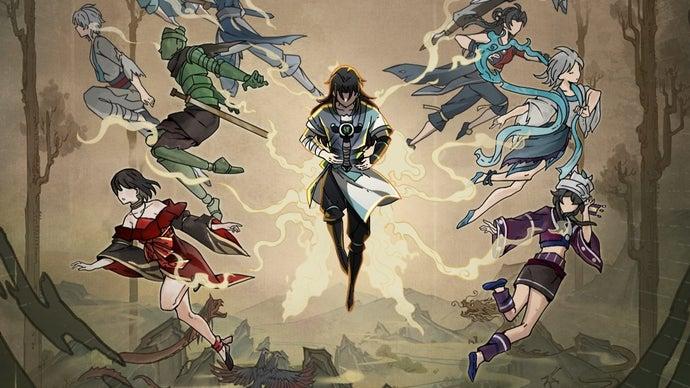
After nearly eight years in Early Access on Steam, the wuxia sandbox RPG The Scroll of Taiwu (太吾绘卷) has finally received its official English translation. Developed by ConchShip Games, the title has already established itself as a massive, multi-million selling success in China. But beyond its commercial triumphs, the game represents something much deeper: a masterclass in original creative expression, spearheaded by lead developer and founder Zheng Jie—widely known in the community as Qiezi (meaning "Eggplant").
Before transitioning into game development, Qiezi worked in architectural design, having shifted during his university years from Chinese literature. This unique background—combining literary appreciation for traditional wuxia (martial arts) narratives with the structured, systems-driven mindset of an architect—heavily influenced the development of The Scroll of Taiwu. Dissatisfied with the prevailing trend of wuxia games heavily styled after Japanese RPGs or restricted to existing licenses (like the works of Jin Yong), Qiezi set out to create an authentic, expansive sandbox that blended traditional Chinese folklore, classical medicine, and mythology.
However, as the game enters the global stage, its development philosophy stands in stark contrast to the modern industry’s obsession with automation. In particular, ConchShip Games’ explicit rejection of generative AI tools in their creative process serves as an important talking point for developers worldwide.
"How Dare We Use Something Like That on Someone's Dream?"
In an industry currently rushing to integrate machine learning into art and asset pipelines, Qiezi’s stance is uncompromising. Regarding the decision to avoid generative AI in the creation of The Scroll of Taiwu, he posed a poignant question: "How dare we use something like that on someone's dream?"
For Qiezi and the team at ConchShip Games, game development is not merely about producing content assets; it is a form of artistic expression, a unique combination of performance and design intended to deliver a deeply personal vision—a "dream"—to the player. They view generative AI not as an innovative shortcut, but as a mechanism for duplicating others' work.
In their view, utilizing generative AI for creative work sends a damaging signal to the player base. It suggests that the developer is willing to take shortcuts rather than engage in the hard, iterative, and deeply human process of handcrafted design. When players invest their time and emotion into a virtual world, they want to feel the intent and passion of the creators behind it. Replacing human artistry with synthesized algorithmic patterns risks cheapening the entire experience.
The Pragmatic Boundary: Creative vs. Administrative AI
It is crucial to note that ConchShip's critique of AI is focused on the creative domain rather than the administrative one. Qiezi has acknowledged that AI tools can have a place in game development, but only in roles that do not dilute the core human imagination of the project.
For instance, using AI to manage development databases, organize schedules, or reduce the communication burden between team members can improve efficiency. However, when it comes to the core creative process—writing the lore, illustrating the characters, designing the systems, and composing the music—AI is not appropriate. These elements require a spark of genuine imagination, the ability to build "something that people didn't think of before."
As a game developer, I find this distinction highly relevant. We must separate tools that optimize our development workflow from tools that replace our creative voice. When we automate the soul of a game, we lose the very thing that makes it resonate.
What Western Developers Get Wrong About the Chinese Market
Alongside their thoughts on AI, the team at ConchShip Games has highlighted major missteps that Western developers frequently make when targeting the Chinese gaming market. For studios looking to expand their global reach, these insights are invaluable.
- Superficial Cultural Integration: Many Western studios try to appeal to Chinese players by grafting superficial Chinese elements—like red lanterns, dragons, or basic folklore references—onto generic game frameworks. Chinese players easily see through these surface-level additions. If a game lacks genuine cultural depth and authenticity, it fails to connect.
- Substandard Localization: Translating text is not enough. True localization requires capturing deep cultural nuances. In a genre like wuxia, which is steeped in classical Chinese philosophy, traditional medicine, and specific historical terminology, literal translations result in confusing and unappealing dialogue.
- Prioritizing Mechanics Over Lore and Culture: Western game design often prioritizes game mechanics first, treating the story and setting as secondary wrappers. However, ConchShip’s developers note that Chinese players are highly motivated by the opportunity to learn about and immerse themselves in rich, authentic cultures. Prioritizing lore and story building is essential for keeping players invested over the long term.
The Power of Handcrafted Systems
By focusing on authentic systems, The Scroll of Taiwu shows what is possible when a studio rejects shortcuts in favor of depth. The game’s intricate systems—which simulate everything from character lineages and martial arts training to traditional Chinese medicine and feng shui—require active player engagement and reward deep investment.
Instead of relying on AI to churn out generic content, the developers focused on creating complex, interlocking sandboxes that feel alive because they are designed with human intentionality. Every mechanic in The Scroll of Taiwu directly supports its cultural themes. The traditional medicine system isn't just a basic health bar; it requires players to balance internal energies and understand the properties of various herbs, drawing directly on real-world historical texts.
This dedication is why the game has sustained a passionate community for nearly a decade. In a landscape saturated with procedurally generated and algorithmically assisted titles, players can tell when a game has been crafted by hand.
Creativity as the Ultimate Competitive Edge
ConchShip Games’ success with The Scroll of Taiwu demonstrates that human-centric development is not just an ethical choice, but a viable business strategy. By staying true to their creative vision, refusing to compromise their art with generative shortcuts, and respecting the cultural intelligence of their audience, they created a landmark title that stands out in a crowded market.
As we look to the future of game design, the success of The Scroll of Taiwu serves as a powerful reminder: the most valuable asset in game development isn't the efficiency of our tools, but the depth of our dreams.
If you want to discuss your own project's design systems or production pipeline, feel free to get in touch via my contact page.