July 18, 2026
9 min read
Palworld's Design Revolution: Rethinking Survival Game Grinding

Key Takeaways
- •The Pitfalls of Traditional Survival Grinding
- •Palworld's Automation Revolution: A Shift in Player Agency
- •The Role of Work Suitability
As game developers, we often grapple with the delicate balance between engaging gameplay loops and the potential for player fatigue. In the realm of survival crafting games, a common pitfall has been the overreliance on repetitive, manual resource gathering – the infamous "chopping down 400 trees" syndrome. For years, players have accepted this as an inherent part of the genre's fantasy. However, the recent viral sensation, Palworld, has offered a compelling counter-narrative, demonstrating that a fresh approach to these core mechanics can significantly enhance player experience and redefine genre expectations.
Palworld's massive success didn't just come from its creature-collecting combat; a significant part of its appeal lies in its radical reinterpretation of the survival crafting loop. By intelligently automating many of the genre's most tedious tasks, Palworld shifts the player's role from a manual laborer to a strategic manager, proving that the fantasy of survival doesn't have to be synonymous with endless, mind-numbing grinding. This guide will deconstruct Palworld's innovative design choices and extract valuable lessons for developers looking to evolve the survival crafting genre.
The Pitfalls of Traditional Survival Grinding
Many survival games immerse players in a harsh world where every resource must be painstakingly acquired by hand. Early game loops typically involve punching trees, mining rocks, and gathering berries, often on repeat for dozens, if not hundreds, of hours. While this initial struggle can be satisfying, establishing a primal connection to the environment, it often scales poorly into the mid and late game.
The fundamental problem arises when these manual tasks become an obstacle to more engaging activities. Players want to build elaborate bases, craft advanced tools, and explore dangerous new biomes. Yet, they are frequently bottlenecked by the sheer volume of raw materials required, forcing them into extended periods of repetitive clicking and waiting. This can lead to:
- Player Burnout: The novelty wears off, and the grind feels like a chore, leading to players abandoning the game.
- Shallow Progression: While numbers go up, the actual gameplay experience doesn't evolve significantly, as the core interaction remains the same.
- Focus Shift: The game inadvertently trains players to optimize for efficiency in grinding, rather than engaging with narrative, exploration, or complex crafting systems.
Developers have often justified this by claiming it's part of the "survival fantasy"—the idea that players must earn every comfort. But Palworld challenges this assumption directly, positing that the fantasy can be just as strong, if not stronger, when the player's struggle is more intellectual than manual.
Palworld's Automation Revolution: A Shift in Player Agency
Palworld’s genius lies in its integration of "Pals" – the game's creature companions – directly into the base-building and resource-gathering loops. Instead of the player being the primary gatherer, Pals take on these roles, transforming the player's agency from direct action to strategic delegation.
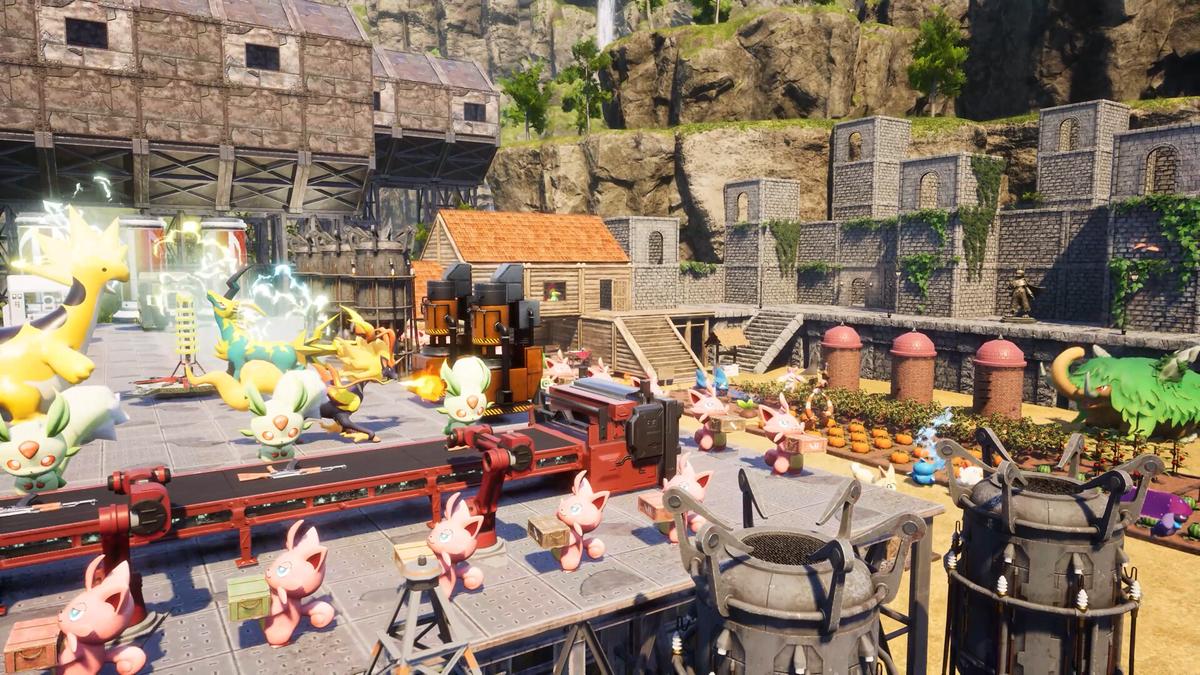
Consider the core loop of resource acquisition:
1. Traditional Survival Game: Player finds tree -> Player equips axe -> Player repeatedly attacks tree -> Tree falls -> Player collects wood. Repeat.
2. Palworld's Approach: Player catches Pal with 'Logging' work suitability -> Player assigns Pal to base -> Player builds Logging Site -> Pal automatically harvests wood from site.
This shift is monumental. It doesn't eliminate resource gathering; it automates the tedium of it. The player's effort is redirected from the repetitive action to the meta-game of Pal management: catching the right Pals, breeding them for optimal work skills, and efficiently designing base layouts to maximize their output.
The Role of Work Suitability
Each Pal in Palworld has specific "Work Suitabilities" such as Logging, Mining, Handiwork, Kindling, Watering, Farming, and more. This system is crucial:
- Specialization: Different Pals excel at different tasks, encouraging diversity in your Pal collection.
- Progression: As players encounter stronger Pals, they gain access to more efficient workers, providing a clear sense of base-building progression tied to creature collection.
- Problem Solving: Base management becomes a puzzle of assigning the right Pals to the right tasks, ensuring all needs (food, production, defense) are met.
This system effectively turns resource generation into a strategic layer rather than a manual one. Players are no longer chopping trees; they are building an ecosystem of workers.
Redefining the Survival Game Loop: From Laborer to Manager
The impact of Palworld's automation extends beyond just resource gathering; it fundamentally alters the entire game loop and player engagement model.
Traditional Survival Loop
In this model, manual gathering is a constant, often unavoidable, prerequisite for progression. It interrupts other activities and can feel like a barrier to fun.
Palworld's Automated Survival Loop
Here, the "gathering" phase is largely automated after initial setup. The player's interaction shifts to managing the automation, freeing them to pursue more dynamic and diverse activities like exploration, combat, and advanced base design. The resource flow becomes a background system that the player designs and optimizes, rather than directly executes.
Designing for "Smart Grinding": Retaining Challenge, Eliminating Tedium
The concern with automation is often that it removes challenge. Palworld deftly navigates this by shifting the challenge from "can you chop enough trees?" to "can you build an efficient, self-sustaining base staffed by the right Pals?"
Lessons for developers:
1. Delegate Repetitive Tasks, Retain Strategic Input: Identify tasks that are inherently repetitive and offer little skill expression beyond early game. These are prime candidates for automation. The player's interaction should then become about managing that automation.
2. Make Automation Itself a Progression System: In Palworld, finding better Pals or breeding for specific traits is the "progression" of automation. This gives players a tangible goal beyond just accumulating raw materials.
3. Introduce Managerial Complexity: Building an efficient Palworld base involves considerations like Pal comfort, food production, pathing, and defense. These complexities ensure that even with automation, the player's strategic mind is engaged.
4. Balance Automation with Direct Interaction: While Pals handle most resource gathering, players still need to venture out to catch new Pals, collect rare materials, or defeat powerful enemies. The balance ensures both direct action and indirect management remain relevant. For instance, while Pals can mine, rare ores might still require player intervention or specific, high-level Pals to acquire.

Case Study: Logging and Mining
Let's look at the specific examples of logging and mining. In many survival games, these are quintessential manual tasks.
- Early Game: Players still manually chop trees and mine rocks in Palworld, similar to other survival games. This teaches the basic mechanics and the importance of these resources.
- Mid Game Transition: Once players capture Pals with 'Logging' or 'Mining' work suitability, they can construct a Logging Site or Stone Pit within their base. Assigning a Pal to these structures initiates automated resource generation. The Pal will continuously harvest wood or stone, depositing it into nearby storage.
- Late Game Optimization: As the base grows, players will seek out Pals with higher work skill levels or specific passive skills that boost efficiency. They might breed Pals to combine desirable traits, further optimizing their resource flow. The challenge becomes building larger, more complex bases that can support more Pals and more advanced production lines.
This system elegantly sidesteps the need for a player to spend hours mindlessly hitting a tree. Instead, that time is spent exploring, fighting, or expanding their Pal collection, which in turn feeds back into more efficient base automation.
Developer Takeaways for Survival Crafting Games
Palworld's design philosophy offers several critical insights for developers seeking to innovate within the survival crafting genre:
1. Question Core Assumptions: Don't assume that a genre's traditional mechanics are sacrosanct. Challenge the "fantasy" you're trying to create and consider if existing mechanics truly serve that fantasy or merely perpetuate tedium.
2. Empower Players through Delegation: Instead of making players do everything, give them tools or companions that can handle repetitive tasks. This empowers players to manage and strategize, rather than simply execute.
3. Design Automation as a Feature, Not a Chore: The act of setting up and optimizing automation should be engaging in itself. This means providing clear feedback, meaningful progression, and strategic choices within the automation system.
4. Focus Player Effort on Meaningful Choices: By automating the mundane, you free up player time and mental energy for more impactful decisions: where to explore, what to build next, which enemies to tackle, or how to optimize their worker force.
5. Integrate Systems Holistically: Palworld's success comes from integrating creature collection directly into base building and resource generation. Look for ways to blend your game's core systems so they reinforce and enhance each other, rather than existing as isolated mechanics.

Palworld has demonstrated that survival games don't need to rely on exhaustive manual grinding to deliver a compelling experience. By rethinking resource acquisition and embracing intelligent automation, developers can create deeper, more engaging gameplay loops that respect player time and attention, ultimately leading to a more satisfying and enduring game. The "chopping down 400 trees" era might finally be coming to an end, paving the way for a new generation of survival crafting games focused on strategic management and dynamic exploration.