July 2, 2026
9 min read
Optimizing LLM Inference for Real-Time Game AI: A Deep Dive into NVIDIA's Inference Software Stack and Token Cost Economics
Key Takeaways
- •The Anatomy of Agentic Game AI vs. Traditional Systems
- •Core Metrics of Real-Time LLM Inference
- •NVIDIA's Three-Layer Inference Software Stack
In the current era of next-generation game design, the industry is witnessing a paradigm shift from deterministic, scripted interactions to dynamic, player-driven experiences. For decades, non-player character (NPC) behavior was bound to finite state machines (FSMs), decision trees, or hardcoded database reads and writes. Today, however, developers are integrating large language models (LLMs) to build real-time, context-aware characters that plan, reason, and adapt. While this unlocks unprecedented depth, it introduces a massive engineering bottleneck: token economics and inference latency.
Traditional game engines operate on a strict frame budget of 16.67 milliseconds to maintain 60 frames per second. While graphics rendering, physics simulation, and audio processing must fit within this budget, executing LLM inference introduces latencies measured in seconds. If an NPC takes five seconds to respond to a player's action, the immersion is instantly shattered. Therefore, the battle for next-gen game AI is not just about model accuracy, but about optimizing the inference software stack to deliver the lowest token cost and sub-second latency at scale.
The Anatomy of Agentic Game AI vs. Traditional Systems
To understand why this is a distributed computing problem, we must examine how agentic game AI differs from traditional web workloads. Traditional web apps are highly predictable: a user loads a page, writes a record to a database, or refreshes a feed. These workloads scale linearly by adding more of the same web servers.
Agentic AI operates under a different paradigm. An agentic game loop does not simply generate text; it involves planning, executing tool calls, querying spatial databases, and spawning specialist subagents. A single player interaction—such as ordering an NPC to plan an ambush—triggers a cascade of sub-tasks: analyzing the terrain, checking inventory, consulting pathfinding algorithms, and negotiating with other NPCs. This turns a single query into a distributed execution graph running across heterogeneous resources: GPUs for LLM inference, CPUs for game logic, and storage systems for long-term memory retrieval.
The diagram below illustrates the architectural complexity of this agentic game loop compared to a classic deterministic system:
Managing this execution flow without wasting compute capacity requires an inference stack that coordinates operations across the entire hardware boundary. Without deep optimization, the latency of multi-agent orchestration quickly becomes prohibitive for real-time game engines.
Core Metrics of Real-Time LLM Inference
When hosting LLM backends for games, developers must focus on three core metrics:
1. Time to First Token (TTFT) / Time to First Response: This represents the duration between a player completing an action and the NPC beginning to reply. In conversational AI, humans perceive a delay of more than 500 milliseconds as unnatural. Maintaining a sub-half-second TTFT is critical. For instance, in healthcare AI testing conducted by DigitalOcean and Hippocratic AI on NVIDIA Blackwell GPUs, throughput was increased by 30% while keeping a sub-half-second time to first response across 10 million patient calls. Game engines require a similarly tight threshold to keep dialogue fluid.
2. Inter-Token Latency (ITL): Once the generation starts, the model must output tokens at a speed that matches or exceeds natural human speech. Natural speech is typically processed at 30 to 50 tokens per second. If the ITL spikes, the text will stutter, causing speech synthesis engines (text-to-speech) to stall.
3. Cost per Token: This is the ultimate economic constraint. If running an LLM-driven NPC costs a fraction of a cent per message, hosting costs for a game with millions of active players will quickly exceed revenue. Game developers must optimize memory footprint and throughput to make LLM integration economically viable.
NVIDIA's Three-Layer Inference Software Stack
To address these metrics, NVIDIA's inference software stack connects three layers to turn individual, isolated optimizations into system-level performance gains:
1. Production Operation Layer
This layer coordinates distributed serving, orchestration, autoscaling, and memory management across multi-GPU setups. In a game server environment, this layer dynamically handles load balancing, ensuring that active gameplay instances receive prioritized GPU memory allocation while idle instances are page-swapped or scaled down.
2. Application Acceleration Layer
This is the core execution runtime where models run with maximum performance. Runtimes like TensorRT-LLM use advanced compilation techniques such as kernel fusion (combining multiple mathematical operations into a single GPU execution step) and overlapping compute and communication to eliminate overhead. For example, Baseten served the DeepSeek V4 Pro model on Blackwell GPUs, applying runtime optimizations to deliver up to 50% more tokens per second. Together AI similarly leveraged TensorRT-LLM on Blackwell to help Cursor accelerate the path from model optimization to production endpoints for real-time coding experiences.
3. Infrastructure Access Layer
This low-level layer exposes GPU, memory, networking (NVLink), and system capabilities without forcing developers to write custom hardware instructions. By co-designing hardware and software, developers can leverage advanced FP4 precision and large expert parallelism over NVLink interconnects.
Compounding System-Level Performance Optimizations
In the past, developers optimized performance by focusing on single components—such as updating a GPU driver or tuning a specific model kernel. In agentic architectures, however, the biggest gains come from compounding system-level optimizations.
When disaggregated serving, large expert parallelism over NVLink, NVFP4 precision, and multi-token prediction are combined, they deliver up to a 20x increase in throughput. Disaggregated serving separates the prompt processing (prefill phase, which is compute-bound) from the token generation phase (which is memory-bandwidth bound). By running these phases on separate, specialized nodes, the system prevents the prefill of new player requests from stalling the active token generation of ongoing conversations.
Furthermore, the Blackwell architecture's native support for NVFP4 (4-bit floating point precision) halves the memory bandwidth required to fetch model weights compared to FP8, directly doubling the generation speed without losing accuracy on reasoning tasks.
The Open-Source Flywheel and Speculative Decoding
The speed at which these optimizations reach developers is accelerated by the CUDA open-source ecosystem. Frameworks like PyTorch have co-evolved with CUDA since 2016, giving developers instant access to hardware features like Tensor Cores and the Transformer Engine.
When breakthroughs are merged into the ecosystem, they run with optimal performance on CUDA hardware from day zero. One key breakthrough is DFlash speculative decoding, which delivers up to a 15x throughput boost on existing hardware. Speculative decoding addresses the memory-bandwidth bottleneck of token generation by using a smaller, ultra-fast draft model to generate a sequence of candidate tokens (e.g., 5-10 tokens) in a single step. The large target model then evaluates the entire sequence in a single forward pass. If the target model accepts the sequence, multiple tokens are generated in the time it would normally take to generate one.
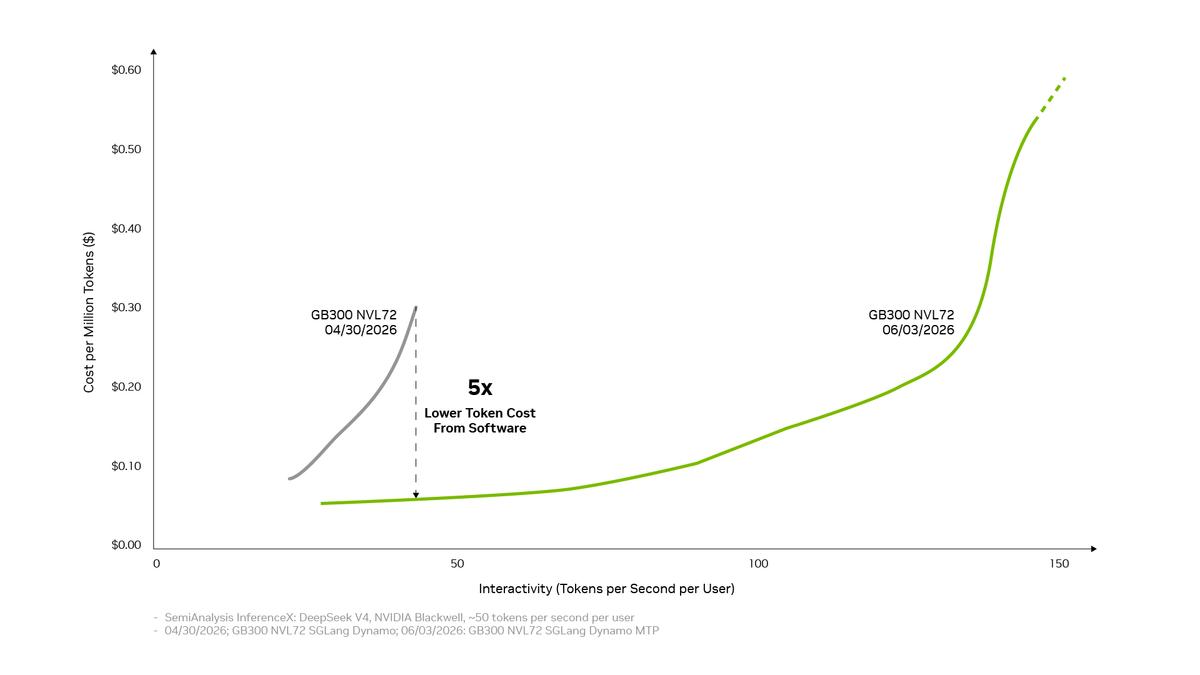
In addition, inference frameworks like SGLang and vLLM have introduced day-zero deployment recipes for DeepSeek V4 on Blackwell. Within about a month of release, DeepSeek V4 performance on Blackwell improved by up to 5x across these frameworks, cutting token costs to roughly one-fifth of their original levels. This open-source flywheel ensures that game developers can adopt state-of-the-art open models and instantly benefit from community-driven performance optimizations.
Engineering Guidelines for Game Engine Integration
For game developers looking to integrate these optimized backends into engines like Unity or Unreal Engine, we recommend the following structural pipeline:
- Use Local Caching for Static Contexts: Do not send the entire game world state in every prompt. Cache static world descriptions, game history, and rules on the inference server, and pass only delta updates (dynamic player actions) to minimize prefill latency.
- Implement Client-Side Streaming: Always stream tokens as they are generated. Use UI text effects (like typing animations) to mask the initial time-to-first-token delay, ensuring the player feels the game is responding instantly.
- Fallback to Traditional AI: Always implement a fallback system. If the inference server experiences a latency spike, the NPC must immediately fall back to a local behavior tree or scripted dialogue to prevent game lockups.
- Enforce Strict Grammar Constraints: Use schema-constrained generation (such as JSON mode or regex parsers at the inference level) to guarantee that the LLM output is always valid JSON that the game engine can parse, preventing format errors from breaking gameplay systems.
Here is a clean C# implementation illustrating how a Unity client can stream responses from an optimized SGLang/vLLM backend using UnityWebRequest and Server-Sent Events (SSE):
By building on top of NVIDIA's optimized inference stack and open-source runtimes, game studios can move past the limitations of scripted logic, creating living, breathing game worlds that remain economically and technically viable at scale.