Optimizing AI Inference for Agentic Systems

Key Takeaways
- •The Rise of Agentic AI in Gaming
- •Core Technical Challenges for Agentic Inference
- •NVIDIA Vera Rubin NVL72: Architecting a Rack-Scale Inference Engine
As a technical director, I've witnessed firsthand the escalating demands placed on AI infrastructure, particularly with the advent of agentic AI systems. These intelligent agents, capable of complex reasoning, planning, and interaction, are poised to transform game development, enabling unprecedented levels of dynamic behavior, adaptive narratives, and responsive game worlds. However, the computational burden of running such sophisticated AI at scale presents a significant challenge. This guide will examine the advanced hardware and architectural innovations from NVIDIA, specifically the Vera Rubin NVL72 rack-scale system and the Groq 3 LPX, designed to meet these exact demands for efficient and scalable agentic AI inference.
The Rise of Agentic AI in Gaming
Traditional game AI often relies on finite state machines, behavior trees, or simple rule-based systems. While effective for many scenarios, these approaches struggle with emergent complexity, dynamic adaptation, and deep reasoning. Agentic AI, in contrast, aims to simulate more human-like intelligence by enabling agents to understand context, plan multi-step actions, and learn from interactions.
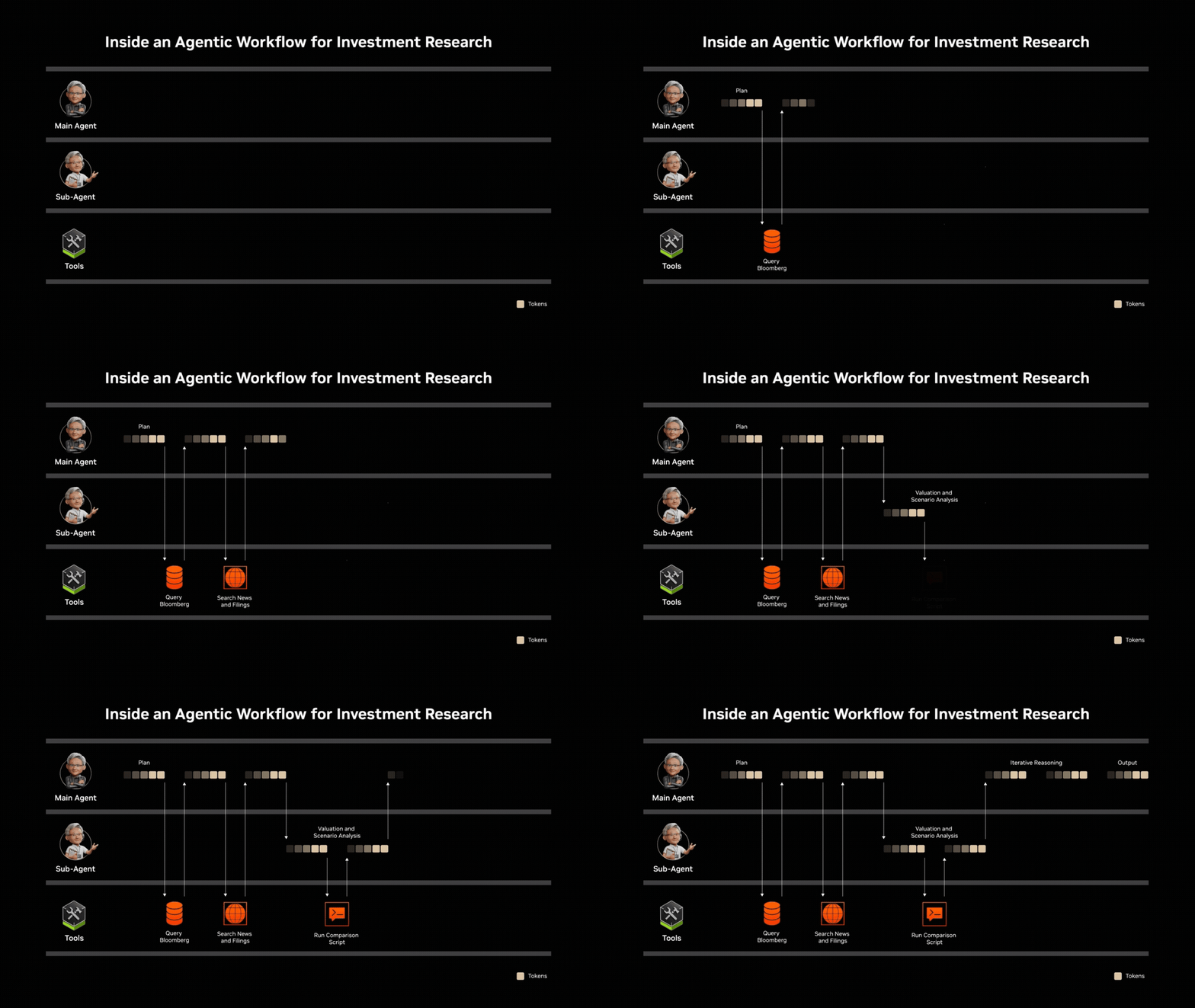
Consider an in-game NPC agent tasked with a complex objective, such as influencing the player's choices or orchestrating dynamic events. This isn't a simple "if-then" script. Such an agent might need to:
1. Query internal game state databases: Access information about player actions, world conditions, and other NPC statuses.
2. Search simulated news and lore: Understand the narrative context and historical events within the game world.
3. Invoke sub-agents for specialized tasks: Delegate specific analytical or predictive tasks to other, smaller AI models.
4. Model player behavior and predict outcomes: Analyze potential player responses to different actions.
5. Synthesize findings and formulate a strategy: Combine all information to decide on the most impactful action.
This multi-faceted process generates an enormous amount of "tokens" – the fundamental units of information processed by large language models (LLMs) and other generative AI. OpenRouter data indicates that agentic AI workloads consume up to 15 times more tokens than a simple chat request. This exponential increase in token consumption necessitates a fundamental change in how we approach AI inference infrastructure.
Core Technical Challenges for Agentic Inference
The primary bottlenecks for deploying sophisticated agentic AI in real-time game environments are:
- Massive Token Generation: Agentic workflows involve iterative reasoning, planning, and knowledge retrieval, leading to a cascade of token generation that far exceeds basic conversational AI.
- Low Latency Requirements: For interactive game experiences, AI responses must be near-instantaneous to maintain player immersion and responsiveness. Slow inference directly impacts gameplay quality.
- High Memory Bandwidth: Processing large contextual windows and complex models requires immense memory bandwidth to feed data to the computational units efficiently.
- Scalability: As game worlds grow and the number of intelligent agents increases, the inference infrastructure must scale seamlessly without compromising performance or efficiency.
NVIDIA Vera Rubin NVL72: Architecting a Rack-Scale Inference Engine
NVIDIA's Vera Rubin NVL72 system emerges as a formidable solution specifically engineered to tackle these challenges. It’s not merely a collection of GPUs but a holistic "AI factory" designed for continuous, high-throughput agentic inference.
System Overview and GPU Configuration
The Vera Rubin NVL72 is a rack-scale system, meaning it's designed as a complete, pre-integrated unit for deployment. At its core, it houses an astonishing 144 next-generation GPUs. This massive parallelism is crucial for handling the concurrent demands of numerous agentic AI processes. Each GPU is equipped with industry-leading processing capabilities optimized for AI workloads.
Crucially, the system boasts an aggregate of 1.7 terabytes (TB) of HBM3e memory. High Bandwidth Memory (HBM) is vital for AI inference, as it provides the rapid data access required to keep the GPUs saturated with information, minimizing latency in token generation and model execution.
NVLink-C2C: The Interconnect Backbone
To unify these 144 GPUs into a single, coherent inference engine, NVIDIA leverages its proprietary NVLink-C2C (Chip-to-Chip) interconnect. This high-speed, low-latency connection technology allows for direct communication between GPUs across the system. In a Vera Rubin deployment, NVLink-C2C connects 144 GPUs across two NVL72 systems, effectively creating a colossal, unified compute fabric. This is critical for:
- Model Parallelism: Distributing extremely large AI models across multiple GPUs.
- Data Parallelism: Processing different parts of an input or multiple simultaneous requests across the GPU array.
- Efficient Data Sharing: Rapid exchange of intermediate results between GPUs, essential for complex, multi-stage agentic reasoning.
Spectrum-X: Scaling Out the AI Factory
While NVLink-C2C handles intra-rack communication, scaling to an entire AI factory requires robust external networking. This is where the Spectrum-X Ethernet networking platform comes into play. Spectrum-X is designed to connect thousands of GPUs across an entire data center, providing the necessary bandwidth and low latency for massive scale-out deployments. For game development studios operating large-scale AI simulation environments or cloud-based agentic AI services, Spectrum-X ensures that the Vera Rubin NVL72 systems can work in concert, forming a truly distributed AI factory.
BlueField-3 SuperNIC: Accelerating Token Generation
The BlueField-3 SuperNIC (Network Interface Card) plays a specialized role in accelerating token generation. Modern NICs are no longer just data pipes; they are powerful processors themselves. The BlueField-3 offloads and accelerates network-intensive tasks, freeing up the GPUs to focus purely on compute. For agentic AI, this means:
- Faster Data Ingress/Egress: Rapidly moving input prompts and generated tokens in and out of the GPU cluster.
- Network Protocol Acceleration: Handling complex network protocols and security features directly on the NIC, reducing CPU overhead.
- Efficient Resource Utilization: Ensuring that network latency does not become a bottleneck for the high-speed token generation capabilities of the GPUs.
The synergy of these components—massively parallel GPUs, high-bandwidth memory, NVLink-C2C, Spectrum-X, and BlueField-3—creates a highly optimized pipeline for agentic AI inference.
Architectural Flow for Agentic AI Inference with Vera Rubin NVL72
Groq 3 LPX: Extending Vera Rubin for Agentic Inference
Complementing the Vera Rubin NVL72, NVIDIA also integrates the Groq 3 LPX in full production to further extend inference capabilities for agentic systems. While the source article doesn't detail Groq 3 LPX's specific architecture, its inclusion signifies a strategic move towards a multi-faceted approach to AI acceleration. Groq is known for its Language Processing Units (LPUs) designed for extreme low-latency inference. This suggests that the Groq 3 LPX likely provides specialized acceleration for certain stages of agentic reasoning, perhaps for sequential token generation or specific model types, working in conjunction with the broader Vera Rubin NVL72 ecosystem to achieve overall optimal performance. This collaboration ensures that the entire inference pipeline, from initial prompt processing to final token output, is highly optimized.
Setting New Efficiency Standards: 30x More Work Per Watt
The ultimate measure of an AI inference system's success is its efficiency and delivered output. NVIDIA's Vera Rubin NVL72 sets a groundbreaking standard by achieving up to 30x more work per watt for agentic AI compared to previous generations. This metric is critical for both operational costs and environmental sustainability in large-scale AI deployments.
Key performance indicators for an AI factory, especially one supporting agentic systems, are:
- Tokens Per Second (TPS): The raw throughput of generated tokens, directly impacting the responsiveness of AI agents.
- Tokens Per Watt (TPW): A measure of energy efficiency, indicating how many tokens are generated for each unit of power consumed. This is where the 30x improvement shines.
- Cost Per Token: The economic efficiency, encompassing hardware, power, and operational costs.
- Utilization: How effectively the hardware resources are being used. High utilization means less idle time and better ROI.
- Uptime: The reliability and availability of the system, crucial for continuous AI operations.
This focus on comprehensive metrics ensures that the AI infrastructure isn't just fast, but also economically viable and sustainable for the long term.
Key Performance Indicators for an AI Inference Factory
Building a "Full Factory" for Game AI
The NVIDIA approach emphasizes designing and building AI infrastructure as a "full factory," rather than just a collection of individual accelerators. This factory operates continuously, and its economics are fundamentally defined by its delivered output. For game developers, this means:
- Predictable Performance: Knowing that the underlying AI infrastructure can consistently deliver the required inference speed and throughput, even under heavy load.
- Scalable AI Capabilities: The ability to scale up complex agentic behaviors, dynamic world generation, and adaptive narrative systems without being bottlenecked by hardware.
- Faster Iteration Cycles: Developers can rapidly test and deploy new AI models and agent behaviors, accelerating the development pipeline.
- Cost-Effectiveness at Scale: The "tokens per watt" and "cost per token" optimizations make it economically feasible to deploy highly sophisticated AI, moving beyond proof-of-concept into full production.
Hyperscalers and AI-native companies building custom XPUs (e.g., NVIDIA's GPUs and Groq's LPUs) must consider the entire pipeline. For game development, this translates into the potential for truly living, breathing game worlds where NPCs exhibit deep, persistent memory, complex social dynamics, and emergent tactical intelligence, all powered by an efficient, dedicated AI inference factory.
Conclusion
Achieving sustained sub-10ms token generation for agentic game AI systems requires deep architectural synergy between high-throughput GPUs and ultra-low-latency LPX inference accelerators. Offloading latency-critical prompt evaluation and speculative token decoding across heterogeneous silicon clusters allows complex reasoning agents to participate smoothly in 60 FPS gameplay loops.
As AI inference economics shift toward maximizing intelligence per watt and dollar, adopting multi-tier inference pipelines will empower studios to deploy rich, unscripted world populations at global scale without breaking infrastructure budgets.
At White Cube Studios, we translate technical architecture into shipping systems across our specialized development pillars: