July 18, 2026
9 min read
NVIDIA Vera Rubin: Maximizing Intelligence per Dollar for Agentic AI Post-Training
Key Takeaways
- •The Rise of Agentic AI and Post-Training Demands
- •NVIDIA Vera Rubin: A Paradigm Shift Through Extreme Co-Design
- •Deconstructing "Intelligence Per Dollar"
As technical directors, we're constantly evaluating the bleeding edge of hardware and software to squeeze every ounce of performance and intelligence out of our systems. In the rapidly evolving landscape of AI, particularly with the advent of agentic AI, the efficiency of AI inference and post-training workloads has become a paramount concern. NVIDIA's latest announcement regarding the Vera Rubin architecture highlights a critical shift in how we approach these challenges: by maximizing "intelligence per dollar" through extreme co-design, specifically targeting post-training operations in the agentic era.
This guide will delve into the technical underpinnings of this strategy, dissecting what "intelligence per dollar" truly means, how "extreme co-design" achieves the "lowest cost per token," and the profound implications for agentic AI in game development and beyond.
The Rise of Agentic AI and Post-Training Demands
The "agentic era" signifies a move towards AI systems that can reason, plan, and act autonomously, often interacting with dynamic environments and making decisions in real-time. In game development, this translates to more sophisticated NPCs, dynamic storytelling, procedural content generation that adapts to player actions, and AI-driven simulation layers that create truly living worlds.
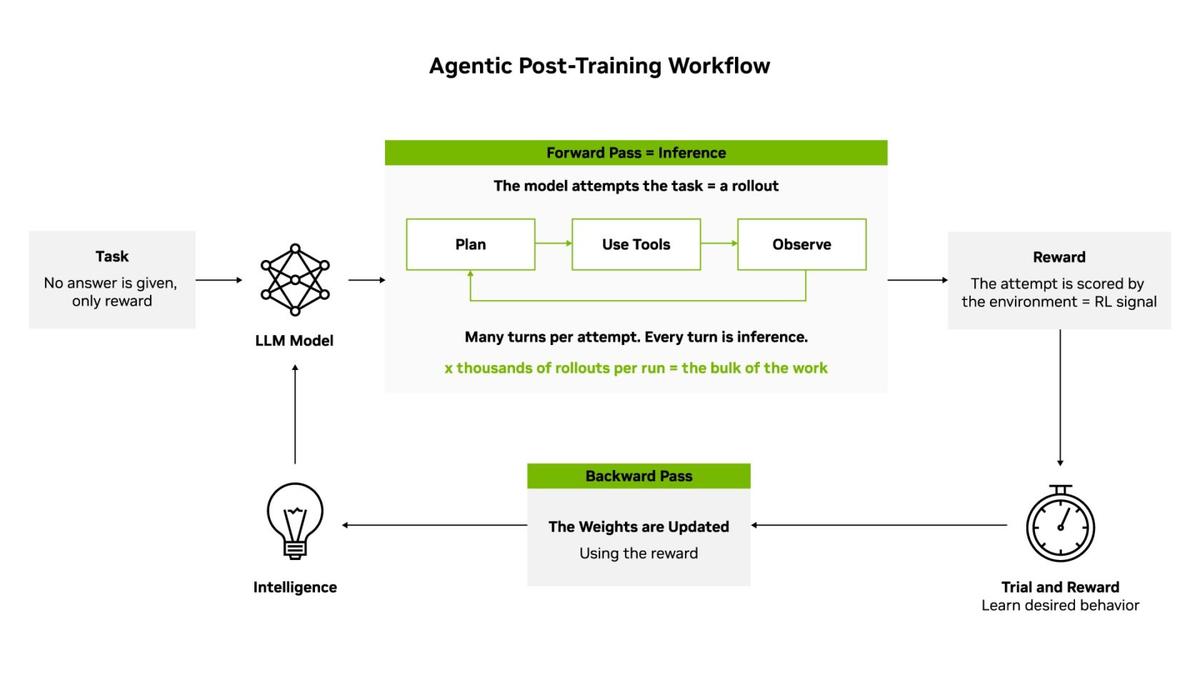
A key component of these advanced AI systems involves "post-training workloads." Unlike initial large-scale model training, post-training refers to the subsequent optimization, fine-tuning, adaptation, and continuous learning phases that occur after a foundational model has been established. This can include:
- Reinforcement Learning (RL) fine-tuning: Adapting agents to specific game mechanics or player behaviors.
- Knowledge distillation: Compressing large models into smaller, more efficient ones for deployment.
- Parameter-Efficient Fine-Tuning (PEFT): Adapting models to new tasks with minimal computational overhead.
- Continuous adaptation: Allowing agents to learn and evolve based on runtime experiences or new game content.
These workloads are distinct from pure inference, often involving iterative updates to model parameters, requiring a flexible yet highly efficient compute platform. The sheer volume and complexity of these operations can quickly become a bottleneck, driving up operational costs and limiting the sophistication of agentic AI systems.
NVIDIA Vera Rubin: A Paradigm Shift Through Extreme Co-Design
NVIDIA's Vera Rubin architecture addresses this challenge head-on by emphasizing "extreme co-design." This isn't just about faster chips; it's a holistic approach that integrates hardware, software, and system architecture to optimize for specific AI workloads. For post-training, this means a tightly coupled design where every component, from the core silicon to the memory subsystem and the inference software stack, is engineered to work in concert to deliver unparalleled efficiency.
The primary goal of Vera Rubin's extreme co-design for post-training is to achieve the "lowest cost per token." In the context of AI, a "token" typically represents a unit of data processed by the model—whether it's an input word, a pixel, or a segment of a generated action. Reducing the cost associated with processing each token directly translates to more efficient AI operations.
This optimization is crucial because post-training, especially in agentic AI, often involves processing vast sequences of tokens during simulation, data generation, or interactive learning loops. A lower cost per token means:
- More iterations: Agents can learn faster and explore more possibilities.
- Larger contexts: Models can process more information, leading to more intelligent decisions.
- Reduced latency: Critical for real-time responsiveness in interactive game environments.
- Lower operational expenditure: Directly impacting the scalability and economic viability of deploying complex AI.
The Vera Rubin architecture is engineered to provide this efficiency, fundamentally changing the economics of deploying advanced AI.
Deconstructing "Intelligence Per Dollar"
The ultimate metric NVIDIA emphasizes with Vera Rubin is "intelligence per dollar." This isn't a vague marketing term; it's a quantifiable measure of the value an AI system delivers relative to its total cost of ownership. For game developers, this means being able to deploy more intelligent, adaptive, and dynamic AI within budget constraints.
The "intelligence per dollar" can be broadly understood as a ratio, where the numerator represents the "intelligence" (e.g., performance, accuracy, capability, complexity of behavior) and the denominator represents the "cost" (e.g., hardware acquisition, power consumption, operational overhead, development time).
The Vera Rubin architecture targets this by:
1. Reducing the denominator: Achieving the "lowest cost per token" directly lowers the operational cost of running AI workloads. This includes optimizing power efficiency, memory bandwidth, and computational throughput specific to post-training tasks.
2. Increasing the numerator (implicitly): By making AI operations more affordable, developers can afford to run more complex models, perform more extensive fine-tuning, and deploy more numerous or sophisticated agents, thereby increasing the overall "intelligence" of their systems.
Consider the following simplified representation of the concept:
Figure 1: Conceptual breakdown of Intelligence per Dollar, highlighting Vera Rubin's impact.
This diagram illustrates how Vera Rubin's focus on reducing the "cost per token" through extreme co-design directly impacts the overall "intelligence per dollar" metric, making advanced AI more accessible and scalable.
The Technical Pillars of Vera Rubin's Efficiency
While specific architectural details of Vera Rubin are proprietary, the concept of "extreme co-design" for "lowest cost per token" implies several key technical optimizations:
1. Memory Subsystem Optimization
Post-training workloads are often memory-bound, requiring frequent access to and manipulation of model parameters and intermediate activations. Vera Rubin likely features:
- High-bandwidth memory (HBM): Integrated directly into the package, providing significantly higher throughput than traditional GDDR memory.
- Optimized memory hierarchies: Intelligent caching and data movement strategies to keep relevant data close to compute units, minimizing latency.
- Specialized memory types: Potentially incorporating new memory technologies or configurations tailored for the access patterns of fine-tuning and adaptation.
2. Specialized Compute Units
While general-purpose CUDA cores remain foundational, "extreme co-design" suggests an emphasis on specialized hardware accelerators for common AI operations within post-training:
- Tensor Cores enhancements: Further optimization for matrix multiplications, crucial for neural network operations, possibly with improved sparsity handling or new data types.
- Dynamic parallelism: Improved ability for the GPU to launch new kernels dynamically, beneficial for iterative and adaptive algorithms often found in RL.
- Flexible data path: An architecture that can efficiently switch between different precision levels (e.g., FP32, FP16, INT8, FP8) to maximize throughput without sacrificing necessary accuracy for fine-tuning.
3. Software Stack Integration
Hardware without an optimized software stack is underutilized. Vera Rubin's co-design extends to:
- CUDA and cuDNN optimizations: Core libraries are meticulously tuned to leverage the new hardware features, providing developers with high-level access to low-level efficiencies.
- Framework-specific optimizations: Deep integration with popular AI frameworks like PyTorch and TensorFlow, ensuring that common operations within these frameworks are mapped optimally to Vera Rubin's architecture.
- Specialized post-training libraries: New or enhanced libraries designed specifically for tasks like reinforcement learning, knowledge distillation, and parameter-efficient fine-tuning, abstracting away hardware complexities while delivering maximum performance.
This tight coupling between hardware and software allows the system to execute complex post-training algorithms with minimal overhead, directly contributing to a lower cost per token.
Figure 2: How Extreme Co-design pillars contribute to maximizing Intelligence per Dollar.
Implications for Game Development
The advancements embodied in NVIDIA Vera Rubin have significant implications for how we design and implement AI in games:
1. More Adaptive and Dynamic NPCs: Imagine NPCs that don't just follow pre-scripted behaviors but continuously learn from player interactions, adapt to new environmental conditions, and evolve their strategies in real-time. Vera Rubin makes the computational cost of such continuous learning more palatable.
2. Advanced Procedural Content Generation (PCG): PCG systems can move beyond simple rule-based generation to agent-driven systems that design levels, quests, or narrative elements based on emergent gameplay and player feedback, with the agents themselves being continuously refined through post-training.
3. Realistic Simulation and World Building: For games with complex economies, ecosystems, or social simulations, Vera Rubin can power more detailed and continuously updated AI models that govern these systems, leading to richer, more believable game worlds.
4. Personalized Player Experiences: Agentic AI can observe player styles, preferences, and skill levels, then dynamically adjust game difficulty, content, or even narrative branches to create a truly personalized experience, with the underlying AI models being constantly fine-tuned.
5. Reduced Development Costs for AI: By lowering the cost per token, developers can iterate faster on AI models, run more experiments, and deploy more sophisticated AI without prohibitive infrastructure costs. This democratizes access to advanced AI capabilities.
The ability to efficiently perform post-training workloads at a low cost is a game-changer. It means that the distinction between "trained AI" and "runtime AI" blurs, allowing for truly dynamic and adaptive systems that can learn and evolve within the game world itself.
Conclusion
NVIDIA's Vera Rubin architecture, with its focus on "extreme co-design" to achieve the "lowest cost per token" for "post-training workloads" in the "agentic era," represents a significant leap forward in AI infrastructure. For technical directors in game development, this translates into a tangible pathway to deploy more intelligent, adaptive, and immersive AI experiences that were previously constrained by computational economics.
By understanding the principles behind Vera Rubin—from the granular optimization of the memory and compute subsystems to the integrated software stack—we can better design our game engines and AI pipelines to leverage these efficiencies. The era of truly intelligent and continuously evolving game AI is not just on the horizon; with architectures like Vera Rubin, it's becoming a practical reality, offering unprecedented opportunities for innovation and player engagement. Embracing this shift will be crucial for staying at the forefront of interactive entertainment.