July 9, 2026
8 min read
Max Single-Threaded CPU Performance: The Critical Path for Agentic AI in Game Development
Key Takeaways
- •The Rise of Agentic AI in Game Development
- •The CPU as the Critical Path for Agentic AI
- •Max Single-Threaded CPU at Scale: A New Category
As game developers push the boundaries of artificial intelligence, particularly with the advent of agentic AI, the underlying hardware requirements are evolving rapidly. While GPUs have long been the workhorses for parallelizable AI workloads like large language model (LLM) inference, a new category of CPUs, characterized by "max single-threaded performance at scale," is emerging as critical for the sophisticated, sequential reasoning tasks inherent in agentic AI systems. This guide will delve into why this specific CPU architecture is becoming indispensable for building responsive, intelligent, and scalable AI agents in games.
The Rise of Agentic AI in Game Development
Agentic AI represents a paradigm shift from traditional scripted AI or simple machine learning models. Instead of merely executing pre-defined behaviors or pattern matching, agentic AI systems are designed to reason, plan, use tools, learn from experience, and adapt their strategies to achieve complex goals. In a game context, this translates to NPCs that can genuinely understand player intent, dynamically respond to unforeseen situations, engage in complex dialogue, or even procedurally generate content based on high-level directives.
These agents typically operate within a loop that involves:
1. Perception: Gathering information from the game environment.
2. Reasoning/Planning: Using an LLM or similar model to interpret observations, formulate goals, and devise a plan.
3. Tool Use/Action: Translating the plan into actionable steps, often involving calling game engine APIs, executing custom code, or interacting with databases.
4. Learning/Memory Update: Incorporating new information or outcomes back into their knowledge base.
This iterative, decision-making process, especially the "tool use" and "code execution" phases, places unique demands on computing resources, often highlighting a bottleneck that traditional highly parallel GPU architectures are not optimized to solve.
The CPU as the Critical Path for Agentic AI
While GPUs excel at the highly parallel computations required for LLM inference (e.g., matrix multiplications), the actual orchestration of an agent's thought process often falls squarely on the CPU. The NVIDIA blog on "Max Single-Threaded CPU at Scale Matters" explicitly states that "the CPU is on the critical path for reasoning, response time and learning." This is a crucial distinction for game developers designing their AI architectures.
Consider the steps an agent takes:
- Reasoning: While the LLM itself runs on the GPU, the preparation of prompts, parsing of responses, and the internal state management of the agent's reasoning process are CPU-bound.
- Tool Calling and Code Execution: When an AI model decides to call a game API, execute a piece of generated code, or query a database, these are sequential operations. A single AI agent might need to perform dozens or hundreds of such discrete, serial tasks within its decision loop. Each tool call is fundamentally a single thread of execution, and its latency directly impacts the agent's overall responsiveness.
- API Calls and Database Queries: Interacting with external systems, even if they leverage other hardware, often involves CPU-driven I/O and data processing.
The diagram below illustrates this critical path within an agentic AI execution loop:
In this loop, the `CPU: Execute Tool / Code / API Call` step (E) is predominantly single-threaded. If this step is slow, the entire agent's response time suffers, regardless of how fast the LLM inference (C) is. This sequential dependency means that the throughput of an agentic AI system isn't simply about raw FLOPS or core count; it's about how quickly these critical, often serial, CPU-bound tasks can be completed.
Max Single-Threaded CPU at Scale: A New Category
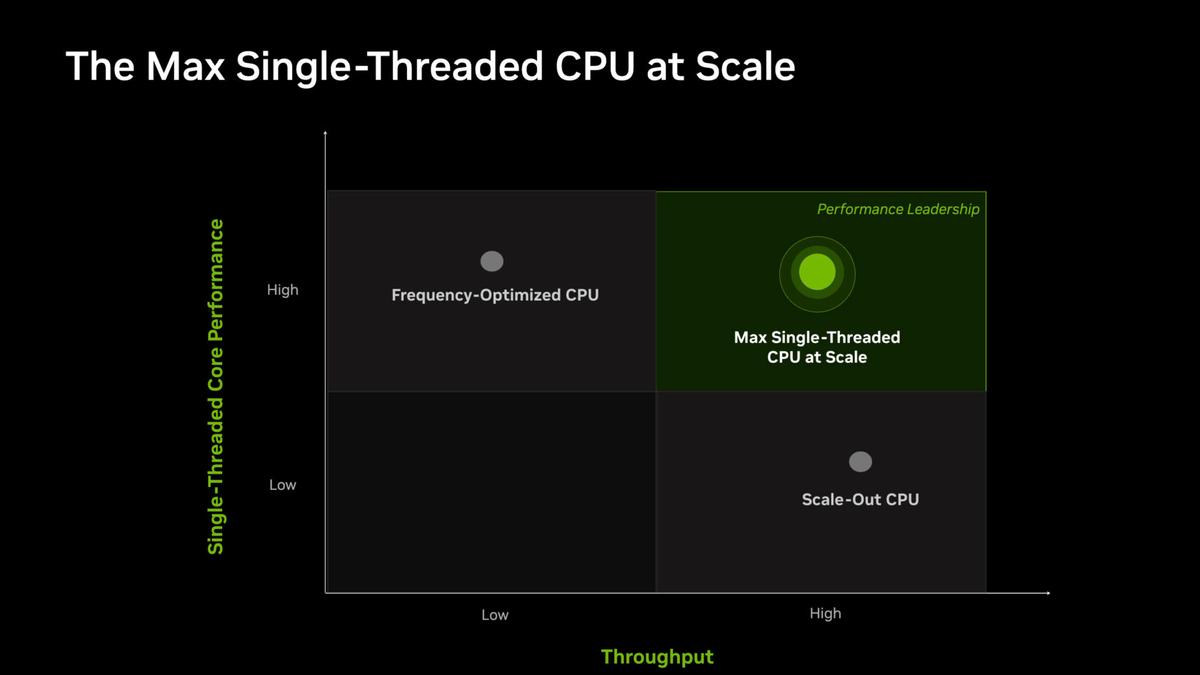
The concept of "Max Single-Threaded CPU at Scale" refers to processors specifically engineered to deliver exceptional performance on these sequential, single-threaded workloads, even when deploying a large number of agents simultaneously. This isn't just about having a few fast cores, but about designing a CPU architecture that can sustain peak single-threaded performance across many instances, often in a server-grade environment.
Traditional data center CPUs often prioritize high core counts for parallel tasks, even if individual core performance isn't at the absolute peak. However, for agentic AI, where each agent's "thought" process involves a series of sequential steps, a slower individual core can drastically bottleneck the overall system. The article highlights that NVIDIA Vera represents this new category, built to address these specific needs for the agentic AI era.
The implications for game development are profound. Imagine a large open-world game with hundreds or thousands of agentic NPCs. Each NPC might be an independent agent, constantly perceiving, reasoning, and acting. If each agent's CPU-bound execution step is slow, the collective performance can grind to a halt. Max single-threaded CPUs aim to alleviate this by ensuring that each individual agent's sequential tasks are processed with minimal latency.
Performance Benchmarking and Real-World Impact
The NVIDIA blog provides compelling data illustrating the impact of this CPU architecture. For agentic AI workloads, NVIDIA Vera, designed for max single-threaded performance, significantly outperforms leading high-core count CPUs.
As shown in the accompanying chart from NVIDIA, Vera achieves approximately 3x higher performance than leading high-core count CPUs for agentic AI workloads. Specifically, Vera processes around 100 tasks per hour compared to roughly 30 tasks per hour on a high-core count Epyc CPU. This stark difference underscores the importance of optimizing for single-threaded performance in agentic AI deployments.
For game developers, this performance delta translates directly into:
- Increased Agent Density: More complex and numerous AI agents can be deployed within the same computational budget, enriching game worlds.
- Enhanced Responsiveness: Agents can react to player actions and environmental changes much faster, leading to more dynamic and believable interactions.
- Deeper Intelligence: Faster execution of tool calls and code allows agents to perform more complex calculations, explore more options, or utilize more sophisticated tools within a given timeframe, leading to "smarter" AI.
- Scalability: The ability to scale agentic AI systems for large-scale multiplayer games or persistent online worlds becomes more feasible.
Architectural Considerations for Game AI Engineers
For game AI engineers and technical directors, understanding this hardware shift is crucial for future-proofing AI architectures:
1. Profile CPU-Bound Agent Tasks: Identify and profile the specific sequential operations within your agentic AI loops. These typically include prompt engineering, response parsing, tool dispatching, game API calls, and custom code execution. These are the areas where single-threaded CPU performance will have the most significant impact.
2. Optimize Tool Execution: Ensure that the "tools" your AI agents use (game API wrappers, utility functions, database interfaces) are as lean and efficient as possible. Minimize overhead in these critical single-threaded paths.
3. Concurrency vs. Parallelism: While LLM inference is highly parallel, the agent's decision-making loop is often a concurrent, sequential process. Design your agent managers to efficiently schedule these sequential tasks across available CPU resources, potentially leveraging asynchronous programming models without sacrificing single-threaded performance for individual agent steps.
4. Hardware Selection: When planning your game's server infrastructure for AI, or even considering client-side agentic AI, evaluate CPUs not just on total core count or clock speed, but specifically on their single-threaded performance benchmarks, especially for integer and memory-intensive workloads common in tool execution.
5. Hybrid Architectures: The future of game AI will likely involve hybrid architectures where GPUs handle large-scale inference efficiently, while high-performance single-threaded CPUs manage the critical orchestration, tool execution, and learning loops of individual agents.
Future Outlook: Co-Designing Hardware and Software for AI Agents
The focus on "Max Single-Threaded CPU at Scale" highlights a growing trend in AI hardware: specialized architectures tailored for specific AI workload patterns. Just as GPUs revolutionized highly parallel deep learning, these new CPU categories are addressing the unique demands of agentic AI's sequential reasoning and tool-use components.
For the game development industry, this means an exciting future where AI can achieve unprecedented levels of intelligence and adaptability. However, it also demands a deeper understanding of the interplay between software architecture and underlying hardware. Game AI engineers will need to move beyond simply offloading tasks to the GPU and consider the entire computational pipeline, recognizing where single-threaded CPU performance is the ultimate bottleneck.
NVIDIA Vera and similar developments underscore that achieving truly intelligent and responsive AI agents in games isn't just about bigger models or more GPUs; it's about optimizing the entire stack, including the often-overlooked, yet critically important, single-threaded CPU performance that drives an agent's ability to reason, act, and learn at scale.
Conclusion
The evolution of agentic AI is redefining the performance bottlenecks in game development. While GPUs remain essential for large-scale model inference, the sequential nature of an AI agent's reasoning, tool calling, and code execution places an unprecedented emphasis on max single-threaded CPU performance. CPUs like NVIDIA Vera, designed to excel in this new paradigm, are becoming the critical component for delivering responsive, intelligent, and scalable AI agents. By understanding and leveraging these specialized CPU architectures, game developers can unlock new levels of dynamic gameplay and create truly immersive experiences driven by advanced artificial intelligence.