July 1, 2026
7 min read
Into the Omniverse: Three Workflows for Improving Vision AI Agent Accuracy With Synthetic Data and Fine-Tuning
Key Takeaways
- •Reusable Starting Points for the Vision AI Lifecycle
- •Workflow 1: Defect Image Generation (Simulating Rare Edge Cases)
- •Workflow 2: Video Data Augmentation (Expanding Scenario Coverage)
The physical world is infinitely complex, dynamic, and unpredictable. As industries transition toward autonomous operations, the demand for Vision AI agents—AI systems capable of processing real-time video streams to understand, reason, and act within physical environments—has surged. These agents are deployed in factories to monitor assembly lines, in warehouses to track inventory, and in smart cities to optimize traffic flow. However, developing Vision AI agents that can operate with high accuracy under varying environmental conditions is one of the most significant engineering bottlenecks of modern AI development.
Traditional Vision AI development relies on a manual, labor-intensive cycle: collect physical video data, manually annotate objects and actions, train the model, evaluate its performance, and repeat. This manual labeling approach suffers from three major flaws: it is prohibitively slow, it is extremely expensive, and it struggles to capture rare, "long-tail" scenarios. If a specific manufacturing defect only occurs once in a million cycles, collecting enough physical images of that defect to train a model is functionally impossible. Furthermore, models trained on static physical datasets frequently suffer from overfitting, failing when deployed to sites with slightly different lighting, shadows, or camera angles.
To solve these challenges, developers are shifting to a simulation-first methodology. By utilizing NVIDIA Omniverse, OpenUSD (Universal Scene Description), and NVIDIA TAO (Train, Adapt, Optimize), engineering teams can build physically accurate digital twins of their operational environments. This allows them to automate dataset creation through synthetic data generation (SDG), programmatically expand scenario coverage, and fine-tune models to site-specific conditions. This guide deconstructs the three core workflows that form NVIDIA's unified lifecycle for improving Vision AI agent accuracy, analyzing their technical architectures, code implementations, and real-world results.
Reusable Starting Points for the Vision AI Lifecycle
NVIDIA Metropolis agent skills and blueprints provide reusable, containerized starting points for building and deploying vision AI applications. Rather than designing custom pipelines from scratch, developers can leverage preconfigured workflows that integrate synthetic data generation, model optimization, and edge-to-cloud deployment.
The core of this lifecycle is the interaction between three distinct but interconnected workflows:
- Workflow 1: Defect Image Generation (Simulating Rare Edge Cases)
- Workflow 2: Video Data Augmentation (Expanding Scenario Coverage)
- Workflow 3: Site-Specific Model Fine-Tuning and Integration (NVIDIA TAO & Metropolis)
Together, these workflows build a continuous "data flywheel" where physical data informs simulation parameters, simulation generates synthetic datasets, and fine-tuned models are deployed back to the edge, with real-world edge-cases fed back into simulation for iterative refinement.
Workflow 1: Defect Image Generation (Simulating Rare Edge Cases)
Manufacturing and quality assurance lines require near-perfect accuracy to prevent defective products from leaving the facility. However, because modern production lines are highly optimized, physical defect data is naturally scarce. To train a vision system to identify a microscopic scratch on an optical fiber or a bent pin on a high-density circuit board, developers need thousands of examples of these precise failures.
NVIDIA addresses this data scarcity through Defect Image Generation. By using OpenUSD-based digital twins and Cosmos foundation models, developers can simulate defects directly on 3D meshes. OpenUSD serves as the common denominator, enabling the composition of CAD files, materials, and textures into a single simulation-ready stage. Within this virtual sandbox, developers can programmatically inject anomalies—such as surface scratches, material discoloration, dented geometry, or structural misalignments—and render photorealistic synthetic training images.
A prime example of this workflow is a collaborative implementation with Corning on an optical fiber production line. The engineering team faced a "previously untrainable" defect class due to an absolute lack of physical examples. By integrating NVIDIA's Defect Image Generation and Cosmos foundation models into the Roboflow platform, they were able to train an optical fiber defect detection model using only eight real defect images augmented with synthetic counterparts.
The resulting model achieved 95% precision and perfect recall. Most importantly, the development cycle—which typically requires multiple quarters of waiting for natural defects to occur on the line—was compressed into just a few days.
Workflow 2: Video Data Augmentation (Expanding Scenario Coverage)
Even when a model is trained on a set of clean, high-quality images, real-world deployment often introduces severe performance degradation. Factors such as camera vibration, lens dust, shifts in ambient lighting (e.g., transitions from morning sunlight to night shifts), and worker obstructions can cause model inference to fail.
Video Data Augmentation solves this by programmatically generating thousands of environmental variations within the simulation stage. Using Omniverse Replicator, developers can create synthetic datasets that capture the full spectrum of operational variables. Replicator allows engineers to write Python scripts that randomize lighting intensity, color temperature, camera positions, focal lengths, motion blur, and the poses of actors and machinery.
Below is a Python script illustrating how to programmatically set up an Omniverse Replicator session to generate synthetic camera and lighting variations for a factory digital twin:
- Define the 3D scene environment path in the Omniverse Nucleus server
- Setup the replicator session and load the OpenUSD scene
- Setup camera variations for scenario coverage
- Setup light variations (simulating daylight shifting and high-bay flickering)
- Trigger frame generation with random poses and annotations
- Bind annotations for bounding boxes and semantic segmentation
By leveraging this programmatic randomization, developers can train their models on edge-case lighting and extreme viewing angles, ensuring that the deployed AI agent remains robust under changing physical conditions.
Workflow 3: Site-Specific Model Fine-Tuning and Integration (NVIDIA TAO & Metropolis)
Once synthetic and augmented datasets are generated, the next step is model optimization. Rather than training models from scratch, which is computationally expensive and requires massive datasets, developers leverage NVIDIA TAO (Train, Adapt, Optimize).
TAO is a CLI-based workflow toolkit that simplifies the fine-tuning of pre-trained models, Vision-Language Models (VLMs), and foundation models. Developers can feed the synthetic dataset generated in Workflow 2 into TAO, using its transfer learning capabilities to adapt the model to the target facility's specific conditions. This process drastically reduces the training time and the quantity of labeled data required.
After fine-tuning, the optimized model is integrated into NVIDIA Metropolis agent skills and blueprints. Metropolis provides reusable, containerized pipelines that handle real-time video stream ingestion, hardware-accelerated decoding, and model inference on edge GPUs. These blueprints enable the AI agent to perform complex, contextual reasoning, such as verifying standard operating procedures (SOPs), tracking human activity, and detecting hazardous conditions.
This combined workflow was successfully deployed on GB300 server production lines. By integrating simulated camera feeds, TAO fine-tuning, and Metropolis micro-action verification, the system achieved 99% task-level accuracy in verifying assembly procedures. This real-time quality control directly resulted in a 3% improvement in first-pass yields, eliminating assembly errors before the servers advanced to the packaging stage.
The following architecture diagram visualizes how the three workflows interact to form a closed-loop data flywheel:
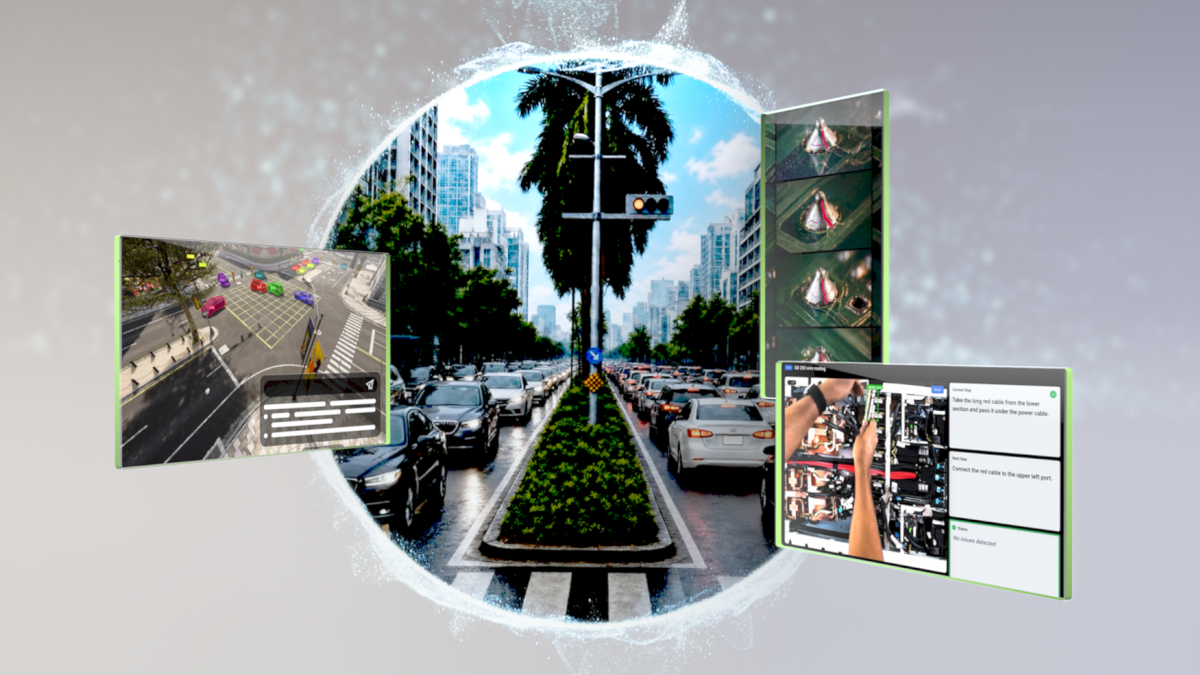
Below, you can view the simulation environment and real-time vision verification systems in action:


Conclusion: The Simulation-First Paradigm
The transition from manual data labeling to a simulation-first paradigm is reshaping how industrial AI is developed. By combining OpenUSD digital twins, synthetic data generation via Omniverse, and model fine-tuning with NVIDIA TAO and Metropolis, enterprises can deploy highly accurate Vision AI agents in a fraction of the time.
For developers, this lifecycle provides a structured, repeatable blueprint for scaling physical AI. The success of Corning in achieving 95% precision with only eight real defect images, and the 3% yield improvement on GB300 server lines, prove that synthetic data is no longer a theoretical alternative—it is the modern standard for physical AI.