NVIDIA Cosmos: Building World Models for Physical AI Systems

Key Takeaways
- •The Imperative of World Models for Physical AI
- •NVIDIA Cosmos Platform: An Overview
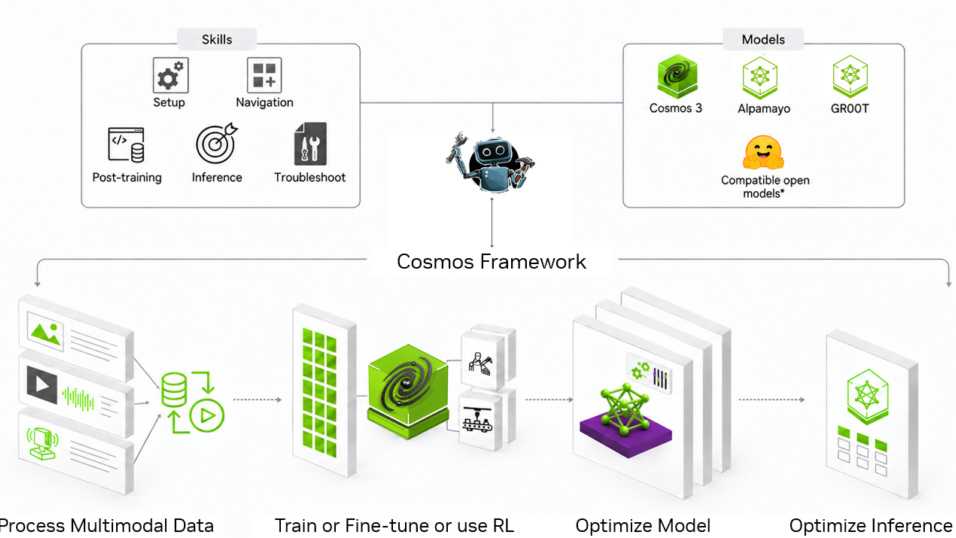
- •The World Model Development Pipeline with Cosmos
As technical directors and senior developers, we constantly seek paradigms that bridge the gap between virtual simulation and real-world intelligence. The emergence of "world models" represents a significant leap, offering a foundational technology for physical AI systems to comprehend and interact with complex environments. NVIDIA's expanded Cosmos platform is at the forefront of this evolution, providing a comprehensive toolkit designed to accelerate the development, evaluation, and deployment of these sophisticated models.
This guide will explore the technical architecture and workflow facilitated by NVIDIA Cosmos, examining how its new training tools, simulation checkpoints, and Cosmos Data Factory blueprints empower developers to rapidly construct robust world models. We will discuss the critical role these models play in enabling physical AI systems to achieve a deeper understanding and more accurate simulation of the real world, ultimately driving the next generation of intelligent agents and robotic applications.
The Imperative of World Models for Physical AI
Traditional AI systems often operate based on reactive policies or learned behaviors within specific, constrained environments. However, for physical AI systems—such as autonomous robots, self-driving vehicles, or advanced industrial automation—to function effectively in dynamic and unpredictable real-world scenarios, they require a more profound understanding of their surroundings. This is where world models become indispensable.
A world model is essentially an internal, learned representation of the environment's dynamics. It allows an AI agent to predict future states, simulate potential outcomes of its actions, and reason about causality without explicit programming for every possible interaction. By internally simulating the world, physical AI systems can:
1. Plan and Predict: Anticipate how the environment will evolve and how their actions will impact it.
2. Learn More Efficiently: Generate synthetic experiences to augment real-world data, reducing the need for extensive real-world trials which can be costly or dangerous.
3. Generalize Better: Adapt to novel situations by leveraging their understanding of underlying physical laws and object interactions.
4. Achieve Robustness: Handle unexpected events or partial observations by inferring missing information from their internal model.
The challenge lies in building these models with sufficient fidelity and efficiency. NVIDIA Cosmos aims to solve this problem by offering a streamlined pipeline for their creation and refinement.
NVIDIA Cosmos Platform: An Overview
The NVIDIA Cosmos platform is an integrated environment designed to facilitate the end-to-end lifecycle of world model development. It provides the infrastructure and tools necessary to go from data generation and model training to rigorous evaluation and eventual deployment. Notably, Cosmos has already demonstrated its efficacy by ranking among the top five on six different open models leaderboards, underscoring its performance capabilities.
At its core, Cosmos leverages NVIDIA's accelerated computing infrastructure, crucial for handling the immense computational demands of training large-scale world models. The platform’s recent expansions introduce key features that further enhance developer productivity and model robustness:
- New Training Tools: Streamlined utilities and frameworks for efficient model learning.
- Simulation Checkpoints: Mechanisms for capturing and restoring simulation states, essential for iterative development and debugging.
- Cosmos Data Factory Blueprints: Tools for generating high-quality, diverse synthetic data tailored for world model training.
These components work in concert to create a powerful environment for developers.
The World Model Development Pipeline with Cosmos
Developing a world model is an iterative process involving data acquisition, model training, evaluation, and refinement. NVIDIA Cosmos provides a structured workflow to manage these stages efficiently.
1. Data Generation: Fueling the Model with Cosmos Data Factory
High-quality, diverse data is the lifeblood of any effective AI model. For world models, this often means vast amounts of sensory input paired with ground truth about environmental states and dynamics. The Cosmos Data Factory Blueprints address this need by enabling developers to generate synthetic data at scale.
Synthetic data offers several advantages. It provides cost-effectiveness by avoiding the expense and logistical challenges of real-world data collection. It also allows for the creation of diverse and edge-case scenarios that are rare or dangerous to encounter in the real world, thus improving model robustness. Furthermore, synthetic data provides perfect ground truth, offering precise labels and environmental parameters that are often difficult to obtain from real sensors.
The blueprints likely offer configurable environments and simulation parameters, allowing developers to specify object types, physics interactions, lighting conditions, and sensor modalities (e.g., cameras, LiDAR, depth sensors). This ensures that the generated data closely matches the operational domain of the target physical AI system.
2. Model Training: Leveraging New Training Tools
Once the data is prepared, the next step is to train the world model. This typically involves complex neural network architectures designed to learn spatio-temporal dynamics. The new training tools within Cosmos are engineered to simplify this process, offering:
- Optimized Framework Integrations: Seamless support for popular deep learning frameworks like PyTorch or TensorFlow, often with NVIDIA's GPU acceleration libraries (e.g., cuDNN, TensorRT) pre-configured for maximum performance.
- Distributed Training Capabilities: Tools to scale training across multiple GPUs or even multiple nodes, crucial for handling large models and datasets.
- Experiment Tracking and Management: Features to log training metrics, model checkpoints, and hyperparameter configurations, enabling developers to compare different model versions and reproduce results.
These tools abstract away much of the low-level infrastructure management, allowing developers to focus on model architecture and training strategies. The goal is to learn a predictive model that can accurately forecast future observations and states given a sequence of past inputs and actions.
3. Evaluation and Refinement: The Role of Simulation Checkpoints
After initial training, a world model must be rigorously evaluated to ensure its accuracy and generalization capabilities. This is where simulation checkpoints become invaluable.
A simulation checkpoint captures the complete state of a simulation environment at a specific moment. In the context of world models, this means:
- Reproducibility: Developers can load a checkpoint and run the world model from a known state, ensuring consistent evaluation across different tests.
- Debugging: If a model performs poorly in a specific scenario, developers can load the checkpoint just before the failure, step through the simulation, and identify the root cause.
- Iterative Improvement: Checkpoints facilitate "what-if" analysis. Developers can modify the model or its parameters, reload a checkpoint, and observe the impact on prediction accuracy or agent behavior without restarting the entire simulation from scratch.
This capability is critical for fine-tuning world models, identifying biases in the training data, and validating the model's performance under various conditions, including stress tests and edge cases.
4. Deployment to Physical AI Systems
The ultimate goal of a world model developed with Cosmos is its deployment to physical AI systems. While the platform focuses on the training and evaluation phases, the output—a highly capable world model—is designed to be integrated into the control loops of real-world agents.
This integration typically involves:
- Inference Optimization: Converting the trained model into an efficient format for real-time inference on edge devices or specialized hardware (e.g., NVIDIA Jetson, DRIVE platforms).
- API Exposure: Providing well-defined interfaces for the physical AI system's control software to query the world model for predictions, state estimations, or planning information.
- Continuous Learning: Designing systems that can periodically update the world model with new real-world data, ensuring it remains accurate and relevant over time.
The ability of Cosmos to produce models that rank highly on open leaderboards suggests that the platform is geared towards generating high-performance, deployable solutions.
Technical Deep Dive: The Architecture of Cosmos
To appreciate the power of Cosmos, it's useful to consider its underlying architecture. While specific implementation details are proprietary, we can infer a layered approach:
Explanation of the Diagram:
- Accelerated Training Infrastructure (I): This foundation leverages NVIDIA GPUs and specialized software stacks (CUDA, cuDNN) to provide the computational power for training complex neural networks.
- Cosmos Data Factory (D) and Synthetic Data Generation (E): This layer handles the creation of diverse, high-fidelity synthetic data, crucial for training robust world models. It likely utilizes advanced physics simulations and rendering engines (e.g., NVIDIA Omniverse) to generate realistic sensory inputs and ground truth.
- Data Storage and Management (F): A robust system to store and organize vast datasets, ensuring efficient data access for the training pipeline.
- World Model Training Tools (G) and Model Architecture Exploration (H): This layer provides high-level APIs and frameworks for developers to define, train, and manage their world models. It includes utilities for hyperparameter tuning, distributed training, and integration with various deep learning model architectures (e.g., Transformers, autoencoders, recurrent neural networks).
- Simulation Checkpoint System (J) and Evaluation and Validation Frameworks (K): These components enable systematic testing and debugging. Checkpoints allow for stateful simulation restarts, while validation frameworks provide metrics and visualization tools to assess predictive accuracy, causality, and generalization.
- World Model - Trained (C): The output of the Cosmos platform, a fully trained and validated world model.
- World Model Inference Engine (B) and Physical AI Systems (A): Represents the deployment phase, where the trained model is integrated into real-world applications, often optimized for low-latency inference on dedicated hardware.
- Development Feedback Loop: Crucially, evaluation results feed back into both data generation (to address data gaps or biases) and the training process (to refine model architectures or training parameters), illustrating the iterative nature of world model development.
This architecture underscores NVIDIA's commitment to providing an integrated, high-performance ecosystem for physical AI.
The Impact on Game Development and Virtual Worlds
While the immediate focus of world models is often on robotics and autonomous systems, the implications for game development are profound. Imagine game AI that can:
- Intelligently Navigate Dynamic Worlds: NPCs that genuinely understand physics and object interactions, reacting realistically to player actions and environmental changes.
- Generate Dynamic Quests and Scenarios: A world model could predict how player actions might unfold, leading to emergent gameplay and dynamic narrative generation, rather than relying on pre-scripted events.
- Enhanced Procedural Content Generation (PCG): A world model could guide PCG algorithms to create more coherent, functional, and believable environments and objects by understanding their physical properties and interdependencies.
- More Realistic Simulations: For simulation games or training applications, world models could drive highly accurate environmental simulations, from weather patterns to complex economic systems, with greater fidelity than traditional rule-based systems.
The capabilities offered by NVIDIA Cosmos could empower game developers to create virtual worlds and AI agents that exhibit unprecedented levels of intelligence, adaptability, and realism, blurring the lines between simulated and physical reality.
Conclusion
NVIDIA Cosmos represents a significant advancement in the field of AI, specifically targeting the complex challenge of building world models for physical AI systems. By providing a comprehensive suite of new training tools, simulation checkpoints, and Cosmos Data Factory blueprints, NVIDIA has created a powerful platform for developers to rapidly iterate on and deploy these critical components.
As technical leaders, understanding and potentially integrating such platforms into our development workflows will be key to unlocking the next generation of intelligent agents, whether they operate in the physical world or within the intricate virtual landscapes we craft. The ability to empower AI systems to truly understand and simulate their environment is not just an incremental improvement; it is a fundamental shift that will redefine what is possible in AI-driven applications and interactive experiences.
At White Cube Studios, we translate technical architecture into shipping systems across our specialized development pillars: