June 14, 2026
6 min read
Meccha Chameleon Camouflage Guide: Mastering the Art of Paint and Pose
Key Takeaways
- •The Core Gameplay Loop: Paint, Pose, and Survive
- •Mastering the Paintbrush: Color Matching and Texture Replication
- •The Physics of Posing: Aligning Geometry and Shadows
In the landscape of multiplayer party games, the stealth genre has often relied on pre-fabricated assets. Games like Prop Hunt have long entertained players by letting them transform into chairs, barrels, or potted plants. However, Meccha Chameleon has completely disrupted this formula, selling over a million copies in its first four days. Developed with a focus on chaotic, streamer-friendly multiplayer antics, the game introduces a revolutionary mechanic: instead of transforming into props, players control blank, white, blob-like figures and must manually paint themselves to blend into their surroundings.
As a game design study and a practical strategy guide, this article breaks down the core mechanics of Meccha Chameleon and outlines advanced techniques that elevate hiders from simple paint-by-numbers targets to masters of pixel-perfect environmental camouflage.
The Core Gameplay Loop: Paint, Pose, and Survive
At its heart, Meccha Chameleon is a asymmetric multiplayer game divided into two distinct roles: Hiders and Seekers.
Hiders are given a crucial preparation window at the start of a match. During this time, they must navigate the map, select a hiding location, and paint their bodies using a built-in art palette. Seekers are released once the preparation phase ends. Their objective is to scan the environment, spot visual anomalies, and tag players before the timer runs out.
Unlike traditional prop-hunt games, Meccha Chameleon relies heavily on a player's artistic precision, geometric alignment, and understanding of environmental lighting. It is not enough to find a dark corner; you must actively paint your character to become the corner.
Mastering the Paintbrush: Color Matching and Texture Replication
The most vital tool in a hider’s arsenal is the eyedropper tool. This utility allows you to sample colors directly from the environment and load them onto your brush. However, beginners often make the mistake of painting their entire character a single solid color.
To achieve high-tier camouflage, you must apply the following structural painting principles:
- Sample Local Surfaces: Use the eyedropper to sample the exact surface you are standing on or leaning against. If you are hiding against a blue wall, sample the blue paint. If you are lying on a wood floor, sample the brown grain.
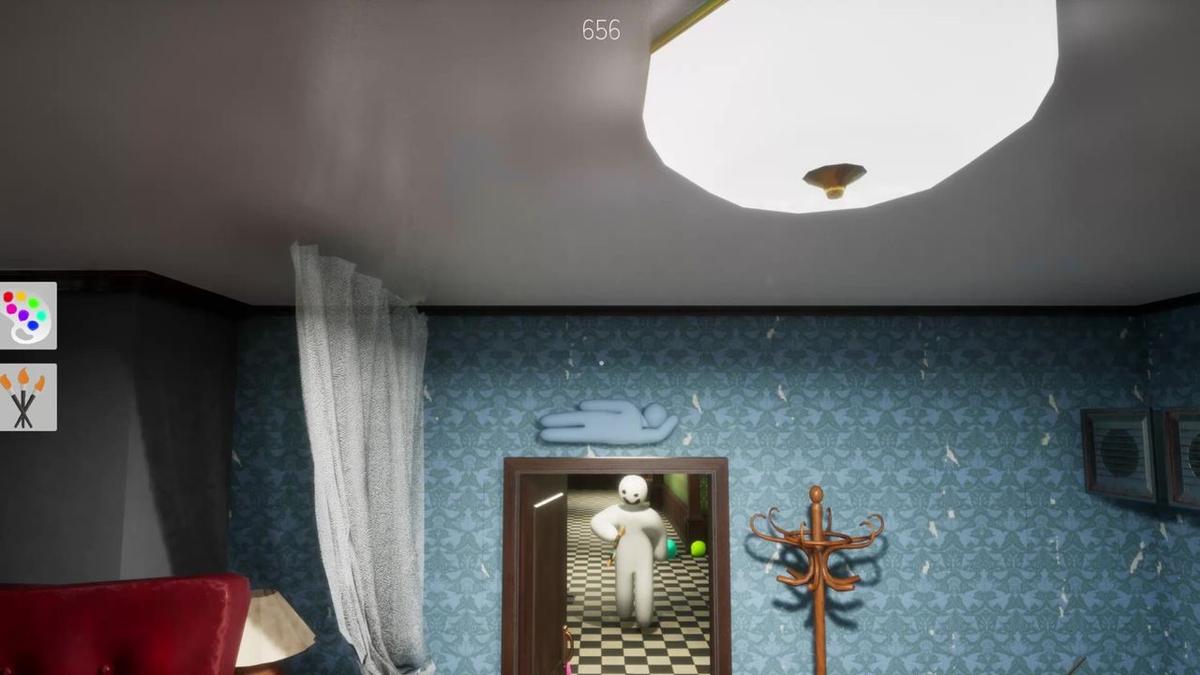
- Replicate Texture Seams: When hiding in a corner or at the boundary between two different materials (such as a tiled wall and a metal pipe), do not choose one color. Paint individual parts of your blob's body to match the intersecting textures. Your legs can match the tiles while your torso and head match the metal pipe.
- Replicate Patterns: If the wall features a wallpaper pattern, use your brush size adjustments to sketch rough approximations of the pattern lines onto your body.
Here is a visual example of a player blending into the environment:
The Physics of Posing: Aligning Geometry and Shadows
Once you have painted your character, your next challenge is positioning. Meccha Chameleon features a lock pose mechanic. When you lock your pose, your character freezes, allowing you to align your silhouette with the surrounding architecture.
1. Shape Hunting and Silhouette Breaking
Experienced Seekers do not just look for color mismatches; they look for abnormal shapes. The human eye is incredibly good at recognizing the smooth, rounded silhouette of the default blob character. To counter this, Hiders must use corners, crevices, and other props to break up their silhouette.
For instance, posing behind a stack of boxes so that only your head and arms are visible—and painting those parts to match the boxes or the wall behind them—greatly reduces your visual footprint.
2. Manual Shadow Shading
In games, lighting is rarely uniform. Even if you match a wall’s base color perfectly, a Seeker will easily spot you if you look like a bright, unlit sticker on a dimly lit wall. You must account for light sources and shadows:
- Ambient Light: If you are hiding near a ceiling lamp, the top of your character will be brighter than the bottom.
- Shadow Mapping: If you are in a shadow, sample the shadow color rather than the wall's base color.
- Gradient Painting: Paint a manual gradient on your character. Use lighter values on the surfaces facing the light source and darker, desaturated tones on the opposite side to mimic natural ambient occlusion.
Seeker Counter-Tactics: How to Spot the Perfect Chameleon
To be a great hider, you must understand how seekers think. When Seekers enter a room, they scan for discrepancies using a hierarchy of visual cues. As a hider, your goal is to pass every check in their scanning workflow.
Seekers will often strike texture seams and corners first, as these are the hardest areas for hiders to paint correctly. To combat this, advanced hiders will choose unexpected spots—like flat, open walls in high-ceiling areas, where seekers rarely inspect closely because they expect hiders to seek cover.
To see these chaotic mechanics in action, watch this gameplay demonstration showing how players use paint and posing to confuse seekers:

Tactical Checklist for Hiders
To maximize your survival rate, follow this quick checklist during the preparation phase of every match:
1. Survey the Room: Do not paint immediately. Find a spot that offers natural silhouette breaks.
2. Sample and Verify: Sample at least three different colors from the spot to use for texture blending and shading.
3. Color the Seams: Ensure your character's boundaries blend perfectly into the surfaces they touch.
4. Simulate Light: Apply darker shades to the parts of your body facing away from light sources.
5. Check Angles: Rotate your camera to ensure your pose does not stick out when viewed from doorways or main seeker paths.
6. Lock Pose: Freeze your position and hold your breath.
By mastering these painting and positioning techniques, you can turn the chaotic arena of Meccha Chameleon into your personal canvas, leaving seekers guessing and securing victory for your team.