June 15, 2026
8 min read
Implementing Machine Information Systems: Bridging Unity Digital Twins, MCP, and Industrial AI
Key Takeaways
- •Introduction: The Operational Shift in Industrial Digital Twins
- •Technical and Regulatory Catalysts: The Global and European Landscape
- •Global Operational Challenges
Introduction: The Operational Shift in Industrial Digital Twins
For years, the value proposition of the industrial digital twin centered almost entirely on visualization. Organizations built high-fidelity, real-time 3D representations of physical assets—replicating machines, lines, and factory floors down to the millimeter. While offering impressive interactive walkthroughs, these models operated as isolated silos. They looked realistic but did not actively solve operational bottlenecks.
Today, across manufacturing, logistics, energy, and industrial automation, the role of the digital twin is shifting. The industry is moving beyond passive visualization toward active systems of record and reasoning. The critical challenge is no longer rendering a realistic mesh; it is connecting live machine state, enterprise data, documentation, and historical knowledge into a single interface that operators, engineers, and AI systems can leverage.
This transition transforms the digital twin into a Machine Information System (MIS)—an operational surface where spatial context and structured metadata converge to drive real-time decision-making.
Technical and Regulatory Catalysts: The Global and European Landscape
This convergence of real-time 3D and data systems is not occurring in a vacuum. It is propelled by a mixture of pressing operational challenges and new global regulatory frameworks.
Global Operational Challenges
Industrial enterprises worldwide face severe headwinds, including:
- Workforce Shortages: Experienced operators and specialized maintenance engineers are retiring, taking decades of tribal knowledge with them.
- Rising Support Costs: Relying on specialized external technicians for remote troubleshooting introduces significant downtime and travel costs.
- System Complexity: Modern production systems are highly integrated, combining mechanical, electrical, and software components that make debugging complex failure states difficult.
Regulatory Pressure: EU Machinery Regulation (EU) 2023/1230
In Europe, this operational evolution is accelerated by the EU Machinery Regulation (EU) 2023/1230. This regulation replaces the older Machinery Directive and mandates major updates to:
1. Digitized Documentation: Transitioning away from paper-based manuals toward structured, digital, and easily accessible lifecycle documentation.
2. Lifecycle Traceability: Ensuring that safety information, machine updates, and operational context are traceable and verifiable throughout the machinery's lifecycle.
3. Cybersecurity Compliance: Establishing clear boundaries and secure operational pathways for connected machinery.
While the regulation is European, its impact is global. OEMs and integrators shipping machinery to European markets must comply, establishing digital documentation standards that benefit their operations worldwide. The structured documentation prepared for compliance also happens to serve as the ideal grounding dataset for modern AI systems.
The Four-Layer Architecture of Machine Information Systems
In the e-book series From Visualization to Action, developed in partnership with Thomas Strigl, CEO of realvirtual.io, a structured architectural model is introduced to explain how these systems connect.
An effective Machine Information System (MIS) functions as an integration layer where multiple streams of data meet. Rather than a standalone 3D viewer, the MIS is built on a four-layer architecture:
1. Live Signal Layer
This layer captures real-time data from the physical machine. It connects directly to Programmable Logic Controllers (PLCs), sensors, and industrial protocols like OPC UA or MQTT. These telemetry data points feed live performance metrics into the system.
2. Enterprise & Context Layer
Real-time signals lack meaning without business context. This layer integrates data from Manufacturing Execution Systems (MES) and Enterprise Resource Planning (ERP) systems. It answers questions such as: Which production batch is currently running? What is the scheduled target? Who is the active operator?
3. Knowledge & Documentation Layer
This layer hosts the structured metadata, manuals, wiring diagrams, and operational history of the machinery. Standardized frameworks like the Asset Administration Shell (AAS) are critical here. AAS acts as a standardized digital twin template, organizing all component metadata and documentation in a format that both humans and software systems can easily parse.
4. Spatial & Visualization Layer
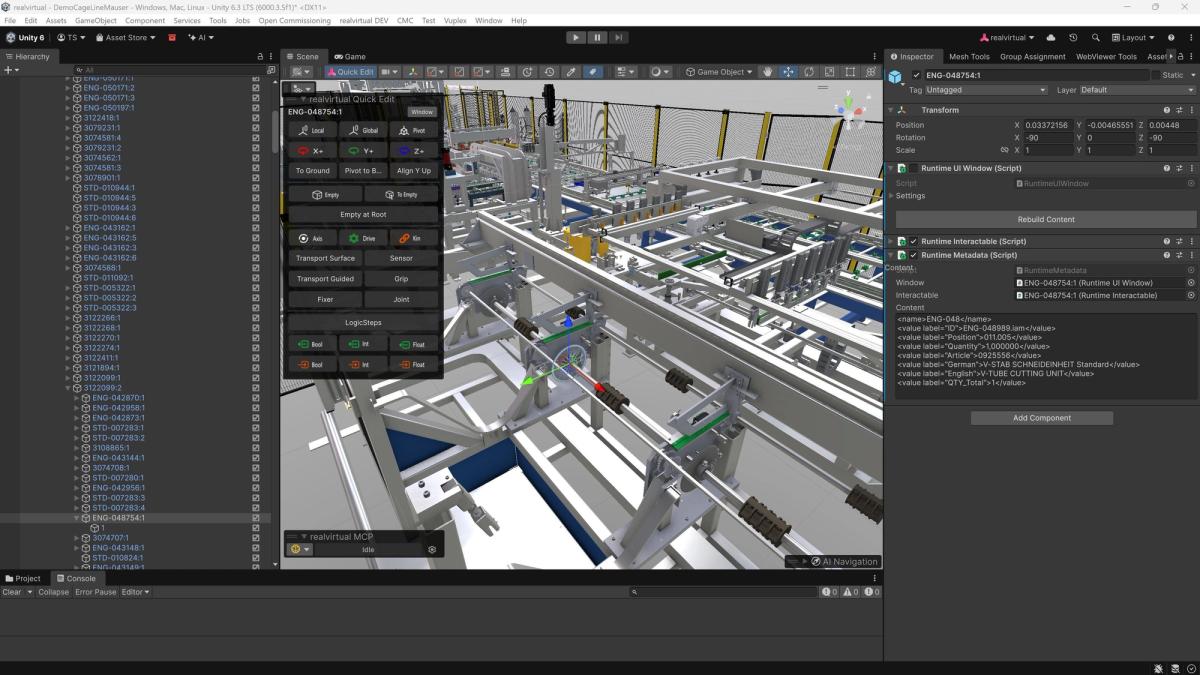
Built using Unity Industry, this layer provides the visual HMI (Human-Machine Interface). It maps the live signals, enterprise context, and structured documentation directly onto a 3D model. When a component fails, the operator does not look up a code in a spreadsheet; they see the specific component flashing red in 3D, with immediate access to its schematics.
The Reasoning Layer: Solving the Grounding Problem in Industrial AI
With a fully developed MIS in place, organizations can introduce the next major evolution: The Reasoning Layer.
Large Language Models (LLMs) and autonomous AI agents have demonstrated massive potential, but deploying them in industrial environments introduces a major barrier: the grounding problem. An LLM trained on public data has no understanding of a specific custom packaging machine, its specific PLC fault codes, or its unique operational history. If asked to troubleshoot, it will hallucinate, presenting a severe safety risk.
To make AI genuinely useful in manufacturing, it must be grounded in four core datasets:
1. Live Machine State: Telemetry, sensor values, and active fault codes.
2. Enterprise and MES Context: Operational schedules, batch details, and system parameters.
3. Manufacturer Documentation: Authoritative manuals, electrical schematics, and maintenance guides.
4. Historical Operational Knowledge: Past maintenance logs and fault resolution histories.
By grounding AI systems in these verified sources, organizations ensure that the AI's reasoning is based on facts, minimizing hallucinations and providing accurate support.
Standardizing AI Integration via the Model Context Protocol (MCP)
Exposing these diverse data sources to AI systems has historically required custom, ad-hoc integrations for every machine. The Model Context Protocol (MCP) solves this integration challenge by acting as an open, standardized bridge between AI systems and industrial data.
MCP provides a uniform interface for LLMs to query live data, search manuals, and inspect historical logs. Instead of writing custom API wrappers for every database and PLC, developers build an MCP server that exposes these resources through standard tool definitions. AI agents can then dynamically call these tools to retrieve the exact context they need to diagnose issues.
Autonomy vs. Assistance: Classifying Industrial AI Agents
When deploying AI agents within a Machine Information System, it is important to categorize their roles based on safety and operational boundaries.
Read-Only Agents
These agents function purely as natural-language interfaces to search documentation. An operator can ask, "What is the torque specification for the main drive motor?" The agent searches the Asset Administration Shell (AAS) data and retrieves the exact value from the manufacturer manual.
Advisory Agents
Advisory agents actively monitor the machine's state. When a fault occurs, they analyze the active PLC signals, reference the manufacturer manuals, inspect historical maintenance logs, and present the operator with a ranked list of likely causes and troubleshooting steps. They do not execute commands; they advise the human in the loop.
Action-Taking Agents
These agents possess the authority to execute commands, such as adjusting cooling rates or triggering self-calibration routines. Due to safety constraints, action-taking agents must operate within strict safety envelopes, often requiring human approval before executing any critical operation.
Practical Technical Blueprints for System Integrators
For system integrators and OEMs, building these systems requires combining real-time engines with structured data pipelines:
- Unity-Based Authoring Environments: Using Unity Industry alongside libraries like realvirtual.io to import CAD data, map PLC signals to virtual components, and link documents to 3D nodes.
- Browser-Based Runtimes: Deploying lightweight WebGL runtimes inside local industrial HMIs, allowing operators to interact with the 3D model directly from their standard browser-based consoles.
- Structured Metadata Pipelines: Implementing automated tools to ingest manufacturer PDFs, parse manuals into semantic databases, and link them to the digital twin via Asset Administration Shell (AAS) files.
- Long-Term Lifecycle Versioning: Tracking mechanical updates in the physical machine and updating the digital twin, ensuring the MIS remains synchronized with the machine's physical state.
Rather than a temporary deliverable, the digital twin is becoming the central, long-term operational interface—the connective tissue linking machines, human operators, documentation, and AI reasoning systems. The architecture needed to support this system is available today, and organizations that build this structured foundation will be the ones positioned to deploy grounded, reliable AI.