June 26, 2026
7 min read
Deconstructing Deltarune Chapter 5: How Toby Fox Evolves Bullet Hell and Puzzle Mechanics
Key Takeaways
- •Introduction
- •The Core Loop: Integrating Battle Grids and Environmental Physics
- •Level Design: The Castle Wall Climb and Ice Physics
Deconstructing Deltarune Chapter 5: How Toby Fox Evolves Bullet Hell and Puzzle Mechanics
Introduction
The release of Deltarune Chapter 5 has sent shockwaves through the indie game development community, launching to an impressive concurrent player count of nearly 300,000 on Steam. While players celebrate the continuation of Toby Fox's quirky narrative, game developers have a unique opportunity to study how the game iterates on its signature genre-bending mechanics. The series has always been celebrated for fusing traditional, turn-based RPG menus with intense bullet hell dodging, but Chapter 5 goes a step further. It refines this formula by introducing context-sensitive physics, spatial map puzzles, and multi-layered gravity changes.
In this developer-centric guide, we will analyze the key systems design choices behind Chapter 5. We will explore the mechanics of the reaction-based Castle Wall Climb, the design and implementation of the sliding ice grid, the layout logic of the Sokoban-style Four Blocks Puzzle, and the intricate gravity shifting of the secret boss encounter, "Pink." By looking under the hood, we can understand how Toby Fox creates high-engagement mechanics that never feel unfair.
The Core Loop: Integrating Battle Grids and Environmental Physics
At its heart, Deltarune relies on a dual-state gameplay loop: world map navigation and battle screen combat. Historically, RPGs treat these two states as completely separate universes with different rules. In Chapter 5, however, Toby Fox builds a cohesive bridge between the map and the battle grid by sharing physics states.
During standard battle sequences, the player controls a small heart (the Soul) inside a constrained bounding box, dodging projectiles in real-time. In Chapter 5, if the battle is triggered on a specific terrain type, the bounding box inherits the properties of that terrain. For instance, battles on ice fields introduce a frictionless movement system to the Soul, where momentum must be carefully managed.
This design decision is visually represented in the system diagram below, illustrating how the combat grid pulls parameters from the world map context:
By linking environmental states to combat mechanics, the developer ensures that the world feels interconnected. The player's spatial awareness on the map directly translates into mechanical preparation for the battles ahead.
Level Design: The Castle Wall Climb and Ice Physics
The level design of Chapter 5 places a greater emphasis on active platforming-style puzzles. The standout example of this is the Castle Wall Climb, a sequence that challenges the player's reflexes and spatial timing.
Instead of simple static barriers, the Castle Wall Climb presents the player with horizontal bars that descend at varying speeds. The player must move Kris upward while timing their dashes to slip through the gaps. To keep this mechanic engaging, Fox employs several smart design choices:
- Visual Cues & Anticipation: Gaps in the descending bars are highlighted with a subtle glow two frames before the bars move, allowing players to plan their path.
- Progressive Difficulty: The climb starts with wide gaps and slow descents. As the player ascends, the gaps shrink, and the bars move in alternating patterns, requiring diagonal navigation.
- Fail-Safe Design: Striking a bar does not deplete the party's HP. Instead, it gently knocks Kris back to the previous checkpoint platform. This minimizes player frustration and encourages experimentation.
Complementing the climb is the new ice sliding physics. When walking on ice tiles on the world map, Kris does not stop immediately upon button release. The velocity decays gradually over several frames. This simple physics tweak makes navigating narrow paths and aligning with switches a puzzle in itself.
Puzzle Design: Deconstructing the Four Blocks Puzzle
Puzzles in Deltarune have always been used to pace the narrative, preventing the player from feeling overwhelmed by constant combat. Chapter 5 introduces the Four Blocks Puzzle, a spatial layout challenge that requires the player to manipulate the positions of four stone blocks to activate matching floor switches.
The design trick of this puzzle lies in the slide-to-stop behavior. When pushed, a block slides in a straight line until it hits a wall or another block. To solve the puzzle:
1. The player must push the first block to create a stop-point for the second block.
2. The second block is then slid into a position that allows the third block to align with its target switch.
3. This chain reaction continues in a clockwise pattern, turning what appears to be a chaotic grid into a highly structured sequence of dependencies.
This puzzle highlights a key lesson in game design: simple rules (sliding blocks that stop on contact) can yield high complexity when combined in a shared space.
Boss Design: The Secret Encounter with Pink
The absolute pinnacle of mechanical complexity in Chapter 5 is the battle with the secret boss, Pink, who resides in a hidden workshop.
Unlocking the Secret Boss
Finding Pink is a reward for players who explore every corner of the level. The player must find and collect 10 Pink Coins hidden behind hidden rooms, optional platforming trials, and fake walls.

Once all 10 coins are collected, the player can unlock the door to Pink's workshop, triggering a fight that completely changes the rules of engagement.
Fight Mechanics: The Blue Soul and Frictionless Combat
During the battle against Pink, the Soul's color changes from red to blue, signaling a shift to the Blue Soul state. In this mode, the Soul is affected by simulated gravity.
- Gravity Orientation: Instead of staying at the bottom of the box, the gravity vector shifts dynamically. Pink's attacks can rotate the box, instantly shifting the bottom of the screen to the left, right, or top.
- Slide Physics: The floor of the bounding box is treated as frictionless ice. Landing after a jump causes the Soul to slide along the platform, making micro-adjustments difficult.
- Bullet Interactivity: Projectiles fired by Pink bounce off the walls, reacting to the same gravity shifts as the player, creating a chaotic but predictable chaotic-system effect.
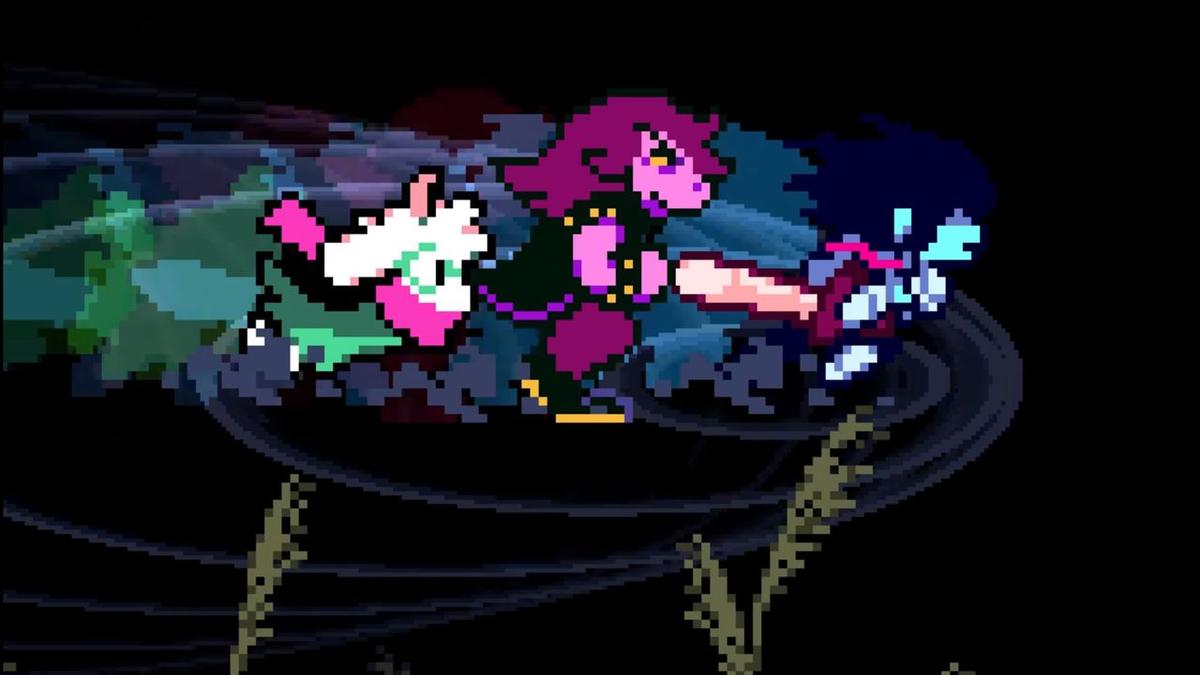
Here is the official trailer for the release, showcasing the gorgeous visual style and fast-paced gameplay of the update:

Developer Takeaways: Designing Intuitive Hybrid Systems
Analyzing Deltarune Chapter 5 offers valuable insights for any game designer building action-adventure games:
1. Mechanical Consistency: Share physics and environmental parameters between exploration and combat states to create a cohesive experience.
2. Visual Clues: Never punish players with sudden, unpredictable obstacles. Use timing, animations, or glows to signpost mechanical changes.
3. Pacing through Variety: Blend reflex-based dodging with logical puzzles to create a rhythm that sustains engagement over hours.
Toby Fox continues to show that indie developers do not need massive budgets or cutting-edge graphics to create deep, memorable, and mechanically rich experiences. Clear rules, clever integration, and polished pacing remain the ultimate tools of the trade.