June 17, 2026
7 min read
Architecting Systemic Tension: Survival Design as Time and Loop Management
Key Takeaways
- •The Mathematics of Plate Spinning in Systems Design
- •Case Study: The 27-Part Vehicle Architecture of Pacific Drive
- •Collision Theory: When Systems Intersect
In the modern landscape of game development, the "survival crafting" genre has become both a massive commercial powerhouse and a design minefield. Dozens of titles flood digital storefronts annually, promising survival mechanics but often delivering little more than tedious chore lists. Players spend hours staring at progress bars, managing inventory slots, and watching hunger meters tick down, yet many of these experiences lack a cohesive emotional core.
During his GDC Festival of Gaming 2026 talk, "Pacific Drive Under the Hood: Survival Fundamentals, Systems Design, and Speeding Past Tropes," Seth Rosen, game director and lead designer at Ironwood Studios, offered a clarifying framework that cuts through these tropes:
"Fundamentally, survival games are time management games... The moment to moment gameplay—gathering materials, crafting, managing, ticking meters—none of that matters. That's the smoke and mirrors. They're just differently patterned plates to spin as you move through the game world. Time is the only real resource."
Rosen, whose career includes a tenure as a technical designer at Klei Entertainment working on the Don't Starve series, argues that many developers mistake the superficial loops of the genre for its actual heart. For systems designers, understanding how to construct, schedule, and collide these "spinning plates" is the key to creating meaningful, friction-filled survival gameplay.
The Mathematics of Plate Spinning in Systems Design
In systems design, a "plate" is not just a UI meter; it is a dynamic feedback loop. Rosen defines a plate as a cycle or loop that the player goes through as problems appear and get resolved. These loops are characterized by three core metrics:
1. Frequency (Spin Rate): How quickly the loop demands player attention (e.g., a fast-draining battery vs. a slow-burning fuel tank).
2. Severity (Stakes): The consequences of failing to maintain the loop (e.g., losing a shield vs. permanent death).
3. Interdependence: How updating or resolving one loop impacts or triggers another.
When a designer builds a survival game, they are not just designing isolated resource sinks. They are designing a network of overlapping schedules. If the spin rates are too uniform, the player falls into a predictable, boring routine. If the spin rates are too chaotic, the game becomes unplayable noise. The sweet spot lies in creating competing demands on the player's primary resource: Time.
By presenting multiple loops with varying frequencies, designers establish cognitive load. The player must use heuristics—mental shortcuts—to prioritize which plate to spin next. Does one search for food now, or risk a night-time run to gather iron? Does one patch the car door, or save the duct tape for a radiator repair?
Case Study: The 27-Part Vehicle Architecture of Pacific Drive
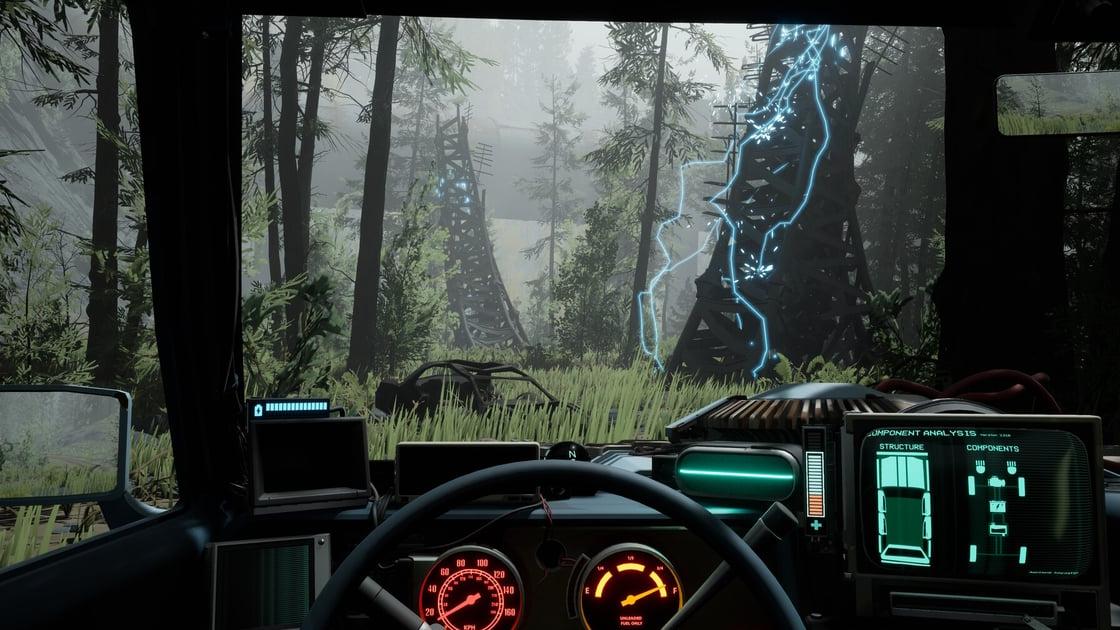
Pacific Drive exemplifies this philosophy by tying the player's survival directly to a singular, highly complex object: a station wagon. Instead of managing a traditional player character hunger meter, the player is responsible for maintaining an intricate mechanical network. The vehicle is composed of 27 distinct parts, each with its own health, status effects, and wear-and-tear cycles.
The maintenance of this vehicle is divided into distinct, overlapping systemic loops:
- Upgrade Progression Loop: Collecting materials out in the Zone to return to the garage and build better components via the Fabrication Station.
- On-Run Maintenance Loop: Patching doors, replacing flat tires, and fixing engine failures in the field using resources gathered on-site.
- Real-time Operational Loop: Juggling fuel consumption, battery charge, headlights, and wipers while actively driving through hostile territory.
The complexity of these 27 parts ensures that the vehicle is never in a static, perfect state. The player is constantly triaging. A damaged engine block might reduce fuel efficiency, which in turn accelerates the depletion of the fuel loop, forcing the player to divert their route to look for siphon opportunities. This cascading failure is where true systemic gameplay emerges.
Collision Theory: When Systems Intersect
A common design pitfall is building systems that operate in parallel but never interact. If the hunger loop, the temperature loop, and the combat loop are completely isolated, the player can easily optimize their playstyle to solve each in sequence.
To prevent this, designers must orchestrate collisions. A collision occurs when two or more cycles demand resolution at the exact same moment, or when a change in one loop drastically accelerates another.
Consider a classic gameplay scenario in Pacific Drive:
1. The Plan: The player is exploring an abandoned research station, seeking high-tier plastics for their next Fabrication Station upgrade. The fuel loop is stable at 60%, and the car's battery is at 80%.
2. The Catalyst: A Bolt Bunny anomaly attaches itself to the car panel.
3. The Collision: The Bolt Bunny shoots electricity through the car body, rapidly draining the battery. The player's headlights flicker and die. The area is pitch black, and the exit gateway is miles away.
4. The Resolution: The player cannot continue searching for plastics. They must drop their current goal, locate the Bolt Bunny, remove it under duress, and find a way to recharge the battery (or navigate back in the dark, risking physical damage to the car's 27 parts).
This sequence illustrates the emotional core of survival: problem-solving under duress. By introducing systemic friction (the Bolt Bunny) that collides with the battery loop, the game forces the player to discard their optimal plan, formulate a new heuristic on the fly, and live out a tiny, self-directed drama.
The Aesthetic of Tension vs. Sandbox "Friendslop"
The survival genre has bifurcated. On one side, we have sandbox, co-op, or "friendslop" titles like Palworld, Satisfactory, and modern Minecraft variants. These games are enormously popular, but they often dilute the survival elements. They act as open-ended construction toys where the threat of failure is minor, and the primary gameplay loop is expansion and automation.
On the other side are single-player, narrative-themed, high-friction games like Pacific Drive. These titles rely heavily on atmosphere, theme, and player fantasy. They use high stakes and systemic danger to forge a deep connection between the player and their tools.
Friction is not a defect in these games; it is the product. Without the risk of a dead battery, the fear of the dark, or the sudden loss of an engine block, the station wagon is just a stat stick. With them, it becomes a trusted companion, and surviving a run becomes a hard-won victory.
Heuristics for Modern Survival Designers
For developers seeking to build survival systems that resonate, Rosen's insights suggest a clear path forward:
- Design for Collisions, Not Isolation: Ensure that status effects, anomalies, and environmental hazards directly feed into and accelerate the depletion rates of core player loops.
- Respect the Player's Time: Do not implement resource-gathering pipelines that only serve to pad the game length. Every resource gathered should directly feed into a choice or relieve a specific pressure point.
- Embrace Single-Player Focus: Single-player survival games allow for tighter control over the pacing and scheduling of systemic crises, enabling more tailored, thematic player fantasies.
Ultimately, survival games succeed not because they force players to click on trees to watch numbers go up, but because they put players in positions of vulnerability, hand them a set of mismatched tools, and say: "Work your way out of this."