Architecting Observability: NVIDIA Minerva's AIOps for Complex AI

Key Takeaways
- •The Challenge of AI Factory Observability
- •NVIDIA Minerva: An AIOps Platform Overview
- •The Pillars of Minerva's Observability
As technical directors, we routinely grapple with the immense complexity of modern software systems, especially in "AI factories"—vast, intricate operations for continuous AI model training, deployment, and scaling. Managing these sophisticated environments demands oversight beyond traditional monitoring. NVIDIA Minerva offers an AIOps platform for end-to-end observability in these critical AI infrastructures.
This guide dissects NVIDIA Minerva's core technical principles, exploring its use of telemetry, purpose-built AI models, and actionable insights to enhance AI factory productivity and reliability. We will then draw parallels to large-scale game development, demonstrating how AIOps principles can maintain robust, performant game ecosystems.
The Challenge of AI Factory Observability
Modern AI development involves a multifaceted pipeline—data ingestion, model training, validation, deployment, and inference—across distributed hardware. An "AI factory" operationalizes this pipeline for continuous, scaled AI model production. These operations are characterized by:
- Vast Scale: Hundreds to thousands of GPUs, interconnected servers, and storage systems.
- Heterogeneous Workloads: Diverse AI models (LLMs, vision models, reinforcement learning agents) with varying computational and data requirements.
- Dynamic Nature: Constant model retraining, updates, and shifts in inference patterns.
- Interdependencies: Complex relationships between hardware, software, data, and model performance.
In such environments, identifying root causes—hardware faults, software bugs, data pipeline bottlenecks, or model degradation—is challenging. Downtime is costly, and inefficiencies hinder AI innovation. Traditional monitoring, relying on predefined thresholds and manual alert correlation, is overwhelmed by the data volume. This necessitates an intelligent, automated AIOps approach.
NVIDIA Minerva: An AIOps Platform Overview
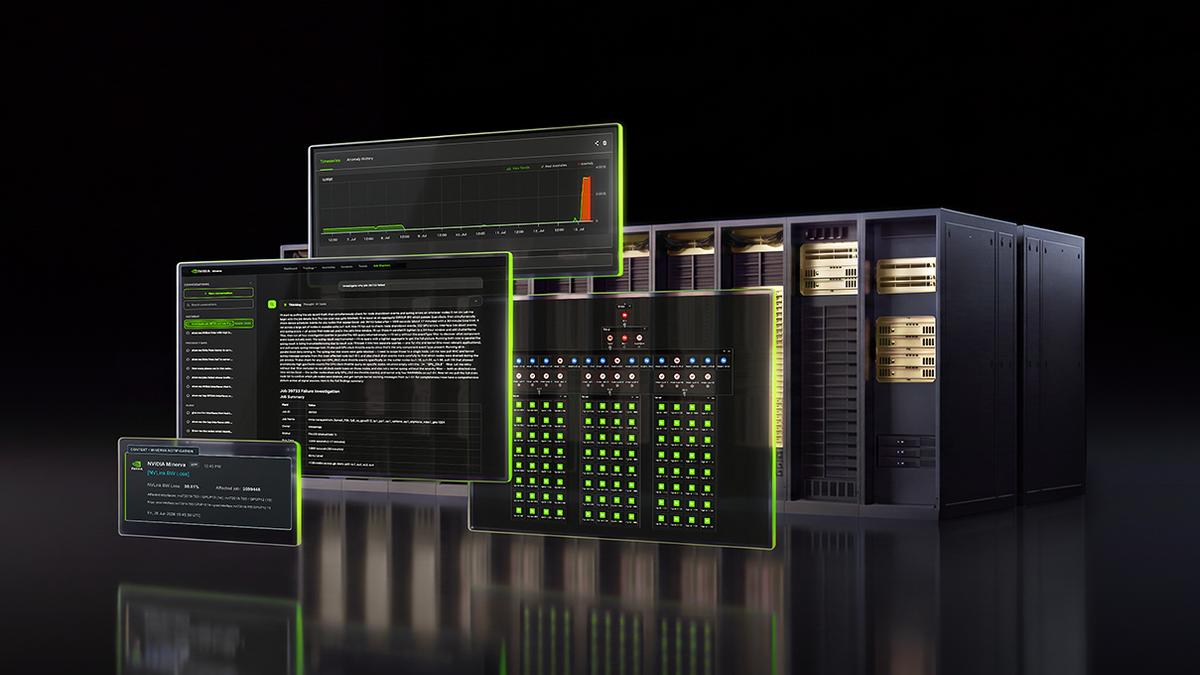
NVIDIA Minerva is an AIOps platform engineered to address observability gaps in complex AI factory environments. Its twofold purpose is to find problems earlier and keep AI factories productive. By integrating advanced AI into operational workflows, Minerva transforms reactive troubleshooting into proactive problem prevention and resolution.
Minerva is not merely a data aggregator; it's an intelligent system understanding AI infrastructure and workload behaviors. It moves beyond simple dashboards, providing actionable intelligence that guides operators and developers directly to issue sources, or predicts them pre-manifestation.
The Pillars of Minerva's Observability
Minerva's end-to-end observability is built upon a robust architecture, broken into three critical pillars: comprehensive telemetry integration, intelligent AI-powered analysis, and the generation of actionable insights.
Telemetry Integration: Gathering Data from Infrastructure and AI Workloads
Effective observability hinges on comprehensive data collection. Telemetry, in Minerva's context, involves gathering a wide array of data from every layer of the AI factory stack:
- Infrastructure Telemetry: Includes metrics and logs from physical hardware (GPUs, CPUs, memory, network, storage), virtualized environments, container orchestration (Kubernetes), and operating systems. Examples include GPU utilization, memory bandwidth, network latency, and disk I/O.
- AI Workload Telemetry: Focuses on AI model performance and behavior, encompassing metrics like training loss, inference latency, throughput, model accuracy, and resource consumption per workload. It also includes AI application logs.
The challenge is efficient, scalable data collection with fidelity across diverse sources. Minerva unifies this telemetry through a pipeline handling high-volume, high-velocity data streams. This unified view is crucial for correlating events and identifying multi-layer patterns.
AI-Powered Insights: Applying Purpose-Built AI Models
Minerva differentiates itself by applying purpose-built AI models to ingested telemetry, moving beyond human-defined rules and static thresholds. These AI models are designed for:
- Anomaly Detection: Identify deviations from normal operational behavior, such as unexpected GPU temperature spikes or sudden drops in inference throughput, by learning baseline system behavior.
- Root Cause Analysis: Pinpoint the likely cause of an anomaly, correlating performance drops to network bottlenecks, memory leaks, or inefficient model architectures.
- Predictive Maintenance: Forecast potential failures or performance degradations, enabling preventative action based on trends in hardware health metrics.
- Pattern Recognition and Correlation: Automatically identify complex patterns across different services, including cascading failures or recurring issues, that humans might miss.
The "purpose-built" nature of these AI models suggests they are specialized and optimized for the unique characteristics of AI factory data, rather than generic AI algorithms. This specialization allows for higher accuracy and more relevant insights.
Actionable Intelligence: Turning Data into Timely, Actionable Insight
Minerva's goal is to transform data into "timely, actionable insight." Raw or processed data is only useful if it enables efficient decision-making. Actionable insights provide:
- Prioritization: Identifying the most critical issues based on their potential impact on factory productivity.
- Contextualization: Providing sufficient context, including scope, affected components, and historical data, to accelerate diagnosis.
- Guidance: Offering recommendations or potential remediation steps, reducing time and expertise needed to resolve complex problems.
By delivering timely and actionable insights, Minerva significantly reduces Mean Time To Resolution (MTTR) for incidents. This direct impact on operational efficiency is paramount for continuous AI factory output.
The entire process can be visualized as a continuous feedback loop:
This diagram illustrates the flow from raw operational data to intelligent insights and ultimately to improved system health and productivity.
Why AI Factories Demand Advanced Observability
AI factories are among the world's most complex operations, with immense scale and intricacy pushing traditional IT boundaries. Demand for advanced observability stems from factors inherent to these environments:
- High Stakes: Failures can lead to significant financial losses, development delays, and degraded service quality.
- Interconnectedness: A minor issue in one part of the pipeline can have cascading, unpredictable effects throughout the system.
- Resource Optimization: AI workloads are resource-intensive. Optimal allocation and utilization of expensive hardware like GPUs are critical for cost-efficiency and performance.
- Rapid Evolution: New AI models, frameworks, and deployment strategies constantly emerge, requiring flexible observability solutions.
Minerva's approach is thus a necessity for organizations operating at the forefront of AI development and deployment.
Architectural Implications and Benefits
Implementing an AIOps platform like Minerva requires a sophisticated architecture, typically involving:
- Scalable Data Pipelines: Ingesting, storing, and processing petabytes of telemetry data, often using technologies like Kafka, Spark, or cloud-native data lakes.
- Distributed AI Model Inference: Running numerous AI models on telemetry, demanding significant computational resources, often leveraging the same accelerated infrastructure it monitors.
- Integration with Existing Tools: Seamlessly connecting with monitoring, alerting, and incident management systems (e.g., Prometheus, Grafana, PagerDuty) to augment workflows.
- User-Friendly Interfaces: Providing intuitive dashboards, visualizations, and alerts that translate complex AI insights into understandable formats.
The benefits are profound:
- Proactive Problem-Solving: Shifting from reactive firefighting to anticipating and preventing issues.
- Reduced Operational Costs: Minimizing downtime, optimizing resource usage, and reducing manual troubleshooting.
- Improved Reliability and Performance: Ensuring consistent uptime and optimal AI workload and infrastructure performance.
- Accelerated Innovation: Smooth AI factory operation allows development teams to focus on model innovation.
Lessons for Game Development Infrastructure
While Minerva targets AI factories, AIOps and end-to-end observability principles are highly transferable to game development infrastructure, especially for live service games, large-scale multiplayer platforms, or complex content pipelines.
Consider the parallels:
- Game Servers as "Mini AI Factories": Live game server environments, with interconnected services (matchmaking, persistence, anti-cheat, physics, NPC AI), are complex distributed systems. Performance degradation in one service can cascade, impacting player experience.
- Telemetry from Game Workloads: Deep telemetry from game clients (frame rates, latency, memory), server performance (CPU/GPU load, network I/O, database queries), and game logic (player actions, quest progression) is crucial, mirroring Minerva's AI workload collection.
AI for Operational Insights in Game Dev:
- Anomaly Detection: AI models can detect unusual player behavior (cheating, exploits), server error spikes (bugs), or unexpected drops in player engagement.
- Predictive Scaling: Forecast player load to proactively scale server infrastructure, preventing lag or disconnects during peak times.
- Root Cause Analysis: Correlate client-side performance issues with server events or infrastructure metrics to identify underlying causes.
- Content Pipeline Observability: Monitor CI/CD pipelines, build systems, and asset delivery networks for smooth content updates and deployments.
Embracing an AIOps mindset in game development means moving beyond simple health checks to building intelligent systems that understand the intricate dance between game logic, player experience, and underlying infrastructure. This enables studios to be more proactive, deliver higher quality experiences, and sustain long-term engagement.
Conclusion
NVIDIA Minerva represents a significant step in managing AI factory complexities. By unifying telemetry, applying purpose-built AI models for deep analysis, and delivering actionable insights, it empowers teams to operate critical infrastructures with unprecedented efficiency and reliability. Minerva's lessons extend beyond AI. For technical directors and senior developers, it underscores the growing importance of advanced observability and AIOps principles in architecting robust, scalable, and resilient game ecosystems. As games become more intricate, relying on distributed systems and AI components, the need for intelligent, end-to-end observability will only grow.
At White Cube Studios, we translate technical architecture into shipping systems across our specialized development pillars: