Architecting Next-Gen Game AI with NVIDIA Cosmos World Models

Key Takeaways
- •The Fundamental Change: Understanding AI World Models
- •NVIDIA Cosmos: A Comprehensive Platform for World Model Development
- •Core Components and Workflow Architecture
Technical directors constantly push game development boundaries. The pursuit of intelligent, adaptive game worlds leads to advancements like "world models." NVIDIA's expanded Cosmos platform, designed to train, evaluate, and deploy these models, marks a significant leap for physical AI systems and interactive entertainment. This guide explores the technical architecture and practical implications of NVIDIA Cosmos for next-gen game AI, from enhancing NPC behaviors to driving complex environmental simulations and procedural content generation.
The Fundamental Change: Understanding AI World Models
A world model is an AI system that understands and predicts environment behavior. Unlike reactive AI, it builds an internal world representation, reasoning about future states, planning actions, and simulating scenarios. This capability transforms "physical AI systems"—agents interacting with physical or simulated reality—and significantly upgrades game AI:
- NPC Intelligence: NPCs understand game mechanics, physics, and player intent, enabling emergent, convincing actions.
- Environmental Dynamics: AI predicts and responds to dynamic world elements like fire spread, water flow, or structural collapse.
- Procedural Generation: World models guide consistent content generation—level layouts, quest narratives—by understanding game rules.
- Testing and Debugging: World model-equipped agents intelligently explore game states, identifying bugs and balance issues.
NVIDIA Cosmos engineers the creation and deployment of these complex world models, addressing computational and data challenges.
NVIDIA Cosmos: A Comprehensive Platform for World Model Development
NVIDIA Cosmos is a comprehensive platform for world model development, offering an end-to-end ecosystem from data ingestion and training to evaluation and deployment. It handles the immense scale and complexity required for models simulating real-world physics and intricate logical systems. Cosmos has demonstrated efficacy by ranking among the top five on six open model leaderboards, a critical indicator of its robust performance and the quality of AI behavior it enables.
Core Components and Workflow Architecture
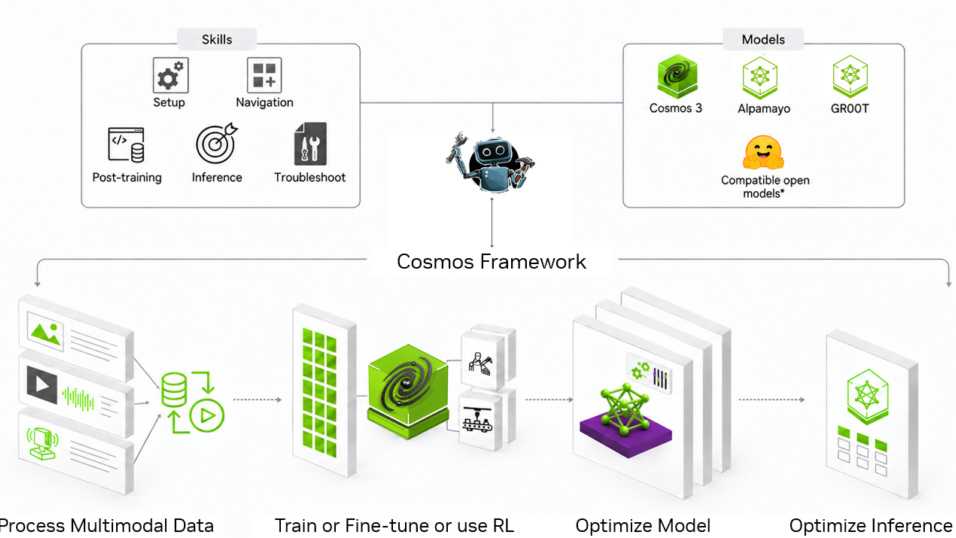
The expanded Cosmos platform streamlines world model development through key components:
1. Cosmos Data Factory Blueprints
Sophisticated world models require vast, high-quality data. Cosmos Data Factory Blueprints provide predefined pipelines for acquiring, processing, and curating this data for game developers:
- Simulation Data Generation: Blueprints guide synthetic data creation from game engines or simulations, recording physics, behaviors, or environmental changes.
- Real-World Data Integration: Blueprints integrate external datasets for games incorporating real-world physics, grounding the world model's understanding.
- Data Augmentation and Labeling: Automated tools augment datasets for variety and apply labels for supervised learning, reducing manual effort.
Efficient data factory operations directly impact training time and world model fidelity; a well-structured pipeline is foundational.
2. World Model Training Tools
With data prepared, Cosmos's training tools provide computational infrastructure and algorithmic frameworks to learn the world model, involving:
- Accelerated Computing: Leverages NVIDIA's GPU architecture for parallelized training, essential for deep neural networks in modern world models.
- Distributed Training: Supports distributed training across multiple GPUs or nodes for large models/datasets, reducing training times.
- Advanced Optimization Algorithms: Implements advanced optimizers and learning rate schedulers for efficient convergence and optimal performance.
- Hyperparameter Tuning: Automates the search for optimal hyperparameters, crucial for high-performing models.
The goal is to train a model that accurately captures the simulated world's causal relationships and dynamics.
3. Simulation Checkpoints
Simulation checkpoints are critical for iterative development and robust deployment, allowing developers to:
- Save and Restore State: Capture a world model's complete internal state at any point for debugging, analysis, and resuming operations.
- Branching Simulations: Experiment with scenarios by loading checkpoints and diverging simulation paths, useful for "what-if" analyses in game design.
- Version Control for AI: Treat world model states as versioned assets, enabling rollbacks, comparisons, and systematic evolution tracking.
This capability enhances developer productivity and deployed AI reliability.
4. Evaluation Frameworks
Cosmos includes robust evaluation frameworks to quantitatively assess trained world model performance and accuracy, involving:
- Predictive Accuracy Metrics: Measures how well the model predicts future environment states from past observations.
- Action Planning Efficacy: Evaluates the quality of actions suggested by the world model for agent goal achievement.
- Robustness Testing: Stress-tests the model under unusual conditions to identify failure modes and areas for improvement.
- Comparative Analysis: Benchmarks developed world models against baselines or other advanced approaches, often using open model leaderboards.
Rigorous evaluation ensures world models are intelligent, reliable, and predictable within the game context.
The entire process can be visualized as a continuous feedback loop:
Figure 1: NVIDIA Cosmos World Model Development Pipeline
Architectural Implications for Game Development
Integrating NVIDIA Cosmos world models into game engines creates unprecedented opportunities:
1. Hyper-Realistic and Adaptive NPC Behavior
NPCs can genuinely understand their environment, anticipate player actions, and devise novel strategies, moving beyond predefined paths. A world model provides an NPC with:
- Predictive Awareness: Understands player movement, available resources, and action consequences.
- Goal-Oriented Planning: Constructs complex plans to achieve objectives in dynamic environments by simulating outcomes internally.
- Emergent Tactics: Enemies coordinate and adapt tactics on the fly, learning from encounters and player behaviors.
This elevates game AI from mere "intelligence" to genuine "understanding."
2. Dynamic and Responsive Game Worlds
World models enable environmental AI directly impacting gameplay. In RTS games, terrain changes dynamically from player actions or disasters. A world model can:
- Simulate Complex Systems: Models fluid dynamics, structural integrity, fire propagation, or ecological changes with high fidelity.
- Generate Dynamic Events: AI triggers realistic environmental events based on predictions from previous actions or game states.
- Reactive Storytelling: Narrative adapts to the world model's understanding of player environmental impact, leading to personalized, emergent stories.
3. Advanced Procedural Content Generation
World models elevate procedural generation beyond hand-tuned rules. An AI with a world model can:
- Generate Coherent Worlds: Creates ecosystems, cities, or dungeon layouts adhering to a learned understanding of element integration.
- Dynamic Level Design: Generates levels adapting to player skill, playstyles, or narrative events, maintaining consistency and challenge.
- Intelligent Asset Placement: Populates environments with logically and aesthetically sensible assets, reducing manual placement.
4. Robust Game Testing and Quality Assurance
Automated testing is crucial, and world models offer a solution for emergent gameplay challenges:
- Intelligent Test Agents: World model-equipped AI agents effectively explore game states, identifying edge cases and interactions missed by human testers or simpler scripts.
- Predictive Bug Detection: World models understand game systems, predicting potential failures or exploits for proactive developer addressing.
- Balance Testing: Simulates thousands of playthroughs to identify balance issues in game mechanics, character abilities, or economic systems, refining player experience.
Integration Challenges and Strategic Approaches
Integrating world models into game development pipelines presents technical challenges, despite immense benefits:
1. Computational Overhead: Training and running complex world models are computationally intensive, requiring significant GPU resources (potentially cloud-based) for development and dynamic AI inference.
2. Data Management: Curating and managing vast training datasets is non-trivial; robust data pipelines and version control are paramount.
3. Model Complexity and Interpretability: Deep learning-based world models can be "black boxes." Understanding predictions and decisions is challenging, complicating debugging and design iteration.
4. Integration with Game Engines: Efficient integration with game engine architectures (e.g., Unity, Unreal) requires careful planning, including efficient APIs for data transfer and optimized real-time inference.
Strategic Approaches:
- Phased Integration: Begin with smaller, contained world models for specific AI systems (e.g., physics prediction) before scaling to full game world models.
- Hybrid AI Architectures: Combine world models with traditional AI (behavior trees, state machines). World models provide high-level understanding/planning; traditional AI handles low-level execution.
- Cloud-Native Development: Leverage cloud computing for training and real-time server-side AI inference, offloading client computational burden.
- Developer Tooling Investment: Invest in tools to visualize world model internals, debug predictions, and interpret complex behaviors.
The Future of Interactive Worlds
NVIDIA Cosmos and world model advancements mark a significant inflection point for game development. AI systems' ability to understand and simulate virtual worlds fundamentally changes interactive experience design. From hyper-intelligent, adaptive NPCs to dynamic, organic environments, next-gen games will offer unprecedented immersion and emergent gameplay. As technical leaders, we must embrace these tools, understand their mechanisms, and integrate them strategically. Studios mastering world model development will shape gaming's future, delivering truly lived experiences. The journey to architect intelligent worlds has begun, with NVIDIA Cosmos as a powerful ally.
At White Cube Studios, we translate technical architecture into shipping systems across our specialized development pillars: