June 24, 2026
8 min read
Architecting Secure Agentic Infrastructure: A Game Developer's Guide to the NVIDIA Agent Toolkit
Key Takeaways
- •The Brain: Deploying Open Models via NVIDIA NIM
- •Modular Capabilities: Verified Skills and CUDA-X
- •Securing the Pipeline: Sandboxed Execution via NVIDIA OpenShell
Architecting Secure Agentic Infrastructure: A Game Developer's Guide to the NVIDIA Agent Toolkit
As game development pipelines scale in complexity, manual workflows for tasks like asset validation, code analysis, performance telemetry ingestion, and localization checks are becoming major bottlenecks. While simple scripting has traditionally solved these, the industry is transitioning from deterministic automation toward full autonomy. With this shift, developers are building custom editor agents that can reason, invoke tools, and collaborate.
However, deploying large language models (LLMs) and agentic frameworks directly into game engine editors presents massive engineering and security hurdles. How do we ensure that an autonomous agent writing C++ or C# script doesn't execute malicious commands, corrupt local databases, or breach security policies?
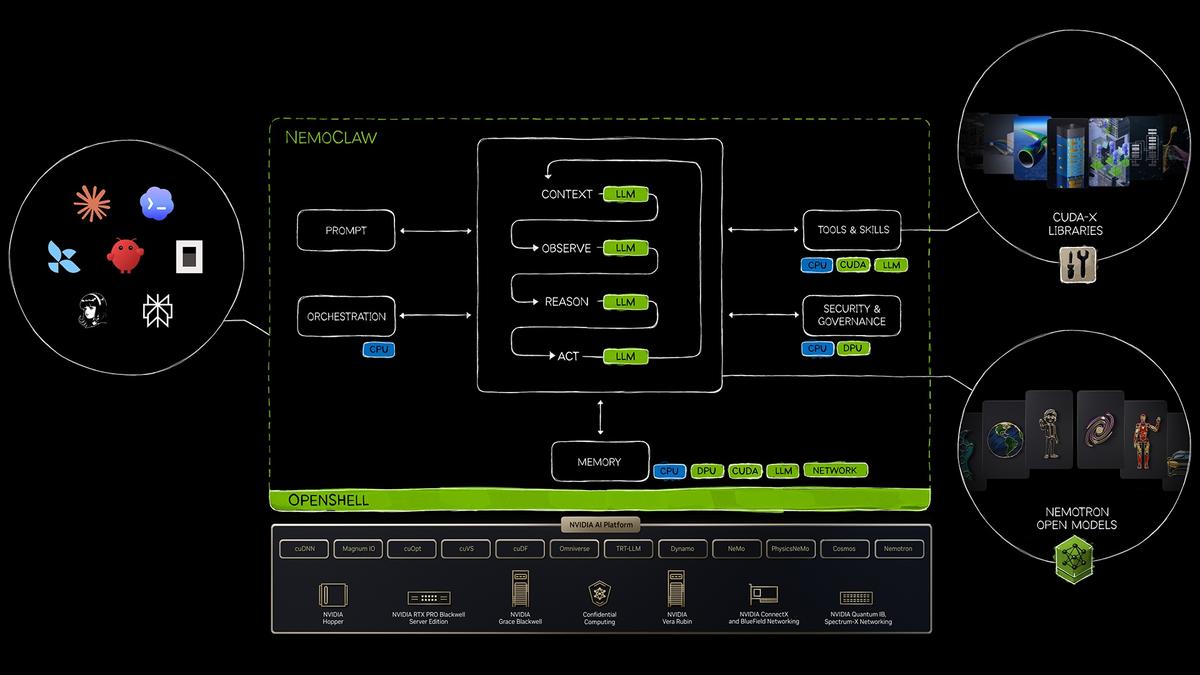
This guide breaks down how to architect a secure, robust agentic system inside your game development environment using the newly released NVIDIA Agent Toolkit. We will explore its components—including open-weight models, secure sandboxed runtimes (OpenShell), and multi-agent coordination (NemoClaw)—and demonstrate how to build an editor pipeline that is both autonomous and safe.
The Brain: Deploying Open Models via NVIDIA NIM
The core of any agentic system is its model. For game development tasks, using generic cloud APIs can lead to latency spikes, security concerns regarding source code exposure, and high recurring costs. The NVIDIA Agent Toolkit addresses this by leveraging high-performance, open-weight models like NVIDIA Nemotron and Cosmos, deployed locally or privately via NVIDIA NIM™ microservices.
NIM microservices containerize models with optimized inference engines (such as TensorRT-LLM), presenting a standard OpenAI-compatible API. For a game engine integration, this architecture offers two critical advantages:
- Sub-Second Latency: Low latency is essential when an agent is providing real-time feedback within the Unity or Unreal Engine editor. Local NIM deployments eliminate network transit, delivering rapid token throughput.
- Context Window Optimization: Technical game dev files—such as long source files, build logs, and scene descriptions—require large context windows. Nemotron's architecture is optimized to handle dense context without degrading reasoning accuracy.
Here is how a game editor extension initiates a secure request to a local NIM instance running Nemotron:
Modular Capabilities: Verified Skills and CUDA-X
An agent cannot interact with the game engine without tools. In the NVIDIA Agent Toolkit, capabilities are structured as Skills. Instead of giving an agent raw shell access, developers expose specific, highly controlled functions as skills.
The toolkit provides verified skills out of the box, but game developers can also map specialized editor capabilities. For example:
- Linter Skill: A tool that compiles a specific file and returns error strings.
- Asset Validator Skill: A tool that inspects asset import settings (e.g., texture compression formats, mesh LOD counts) against target platform budgets.
- Profiler Parser Skill: A tool that parses CPU/GPU timeline captures to identify frame-time spikes.
Beyond simple text processing, the toolkit integrates with CUDA-X Agent Skills. By exposing libraries like cuDF (GPU-accelerated dataframes) or cuOpt (optimization solver), agents can process massive game telemetry databases or optimize complex level generation paths in real time.
Additionally, the framework is designed to be interoperable. If your studio already has agent workflows written in LangChain, CrewAI, or Agno, the toolkit serves as a plug-and-play middleware. You can port existing tools and skills directly into the secure execution layer without rewriting your core logic.
Securing the Pipeline: Sandboxed Execution via NVIDIA OpenShell
The most significant risk of LLM-driven agents is prompt injection or hallucinated actions leading to destructive behavior. If an agent is tasked with "optimizing local code" and decides to run malicious file actions, or if it is tricked via a malicious comment in a downloaded asset into uploading project secrets to an external server, the consequences are catastrophic.
To prevent this, the NVIDIA Agent Toolkit introduces NVIDIA OpenShell™, a secure-by-design runtime environment. OpenShell operates as an isolated sandbox for agent actions, enforcing strict, policy-based access control.
Under OpenShell, every skill execution, file read/write, and network request must pass a validation check against a security policy. The execution boundary operates as a strict shield between the engine editor and host resources.
An OpenShell policy is defined declaratively. Here is an example configuration that restricts an agent to a specific workspace directory, blocks outbound internet requests (except to the local NIM service), and sanitizes shell commands:
When the coordinator requests the agent to execute a script refactoring tool, OpenShell validates the path against `allow_write`. If the model attempts to modify a plugin dll inside the restricted `Plugins/` folder, the execution is immediately blocked at the sandbox layer, raising an alert without interrupting the editor thread.
Orchestration & Multi-Agent Collaboration: NVIDIA NemoClaw
Rarely does a single agent handle an entire pipeline. Complex tasks require specialized agents working together. The toolkit manages this orchestration using NVIDIA NemoClaw™, customizable open blueprints for agent coordination.
NemoClaw provides the scaffolding for:
1. State and Memory Management: Retaining context across long-running development loops.
2. Task Deconstruction: Breaking a complex request (e.g., "Analyze frame rate spikes in Level 3 and fix the culprit script") into smaller, sequential steps.
3. Multi-Agent Communication: Allowing a "Coordinator Agent" to delegate tasks to a "Profiler Agent" and a "Code Refactoring Agent."
Let's visualize how a NemoClaw sequence coordinates these specialized agents inside the game editor environment:
By segmenting responsibilities, we limit the blast radius. The Profiler Agent only needs read access to logs, while the Code Refactoring Agent only needs write access to the generated scripts directory. Neither has direct access to the network or critical project settings.
Observability, Instrumentation, and Evaluation
A robust architecture requires testing. Autonomous agents can be unpredictable; small variations in input prompts or model updates can alter behavior. The toolkit provides built-in observability hooks, allowing you to trace reasoning steps, monitor token consumption, and audit latency bottlenecks.
By integrating with tracing solutions (such as LangSmith or open-telemetry protocols), developers can inspect the exact prompt templates, retrieved database documents, and tool execution times. This makes debugging agent behavior in editor extensions a deterministic process.
To evaluate agents before deploying them to your studio's development team, you can build custom evaluation harnesses using the NeMo evaluation framework. This evaluates:
- Fidelity: Does the agent follow game code conventions (e.g., camelCase, PascalCase)?
- Safety: Does the agent attempt to escape the sandbox when presented with adversarial user input?
- Correctness: Does the generated code compile without warnings?
Conclusion
Integrating autonomous agents into game development pipelines is a powerful strategy to accelerate workflows, but it must be done with security and performance as primary design requirements. The NVIDIA Agent Toolkit provides the necessary building blocks to achieve this:
- In-Editor NIM Microservices to ensure low-latency, private, and fast inference.
- Verified Skills to expose engine APIs safely.
- NVIDIA OpenShell sandboxing to establish strict execution boundaries and prevent destructive filesystem or network actions.
- NVIDIA NemoClaw blueprints to coordinate complex, multi-agent operations.
By establishing this architecture, studios can safely unlock the power of agentic AI, turning their game engine editors into truly autonomous development platforms.